
I. What Does Light Reveal?
Light makes the world visible. Yet in Hsiao Chin’s paintings, what it illuminates extends beyond the world’s outward appearance.
In physics, visible light is electromagnetic radiation capable of stimulating visual perception; in painting, colour enters our experience through the interaction of light, materials and the eye.[1] This explanation alone, however, cannot account for why certain paintings convey luminosity without depicting a source of light, or why, within a field of darkness, a quiet, reassuring radiance may emerge.
Hsiao Chin’s painting unfolds at this threshold. Light is both a visual experience generated by colour and space, and a spiritual metaphor for inward awareness. Rather than simply translating the invisible into recognisable images, he uses circles, lines, colour fields and intervals to evoke relationships that extend beyond the world of objects. The light within his paintings need not originate from the sun, nor depend upon any depicted object. It may arise between a centre and its surrounding space, or within the viewer’s sustained attention.
For Hsiao, therefore, the question “What is light?” gradually becomes another: what enables life, amid uncertainty, to retain a sense of connection with itself and with the world?
This question runs through his practice, from his early experiments in abstraction to his final works. It also gives the “universe” a meaning distinct from an astronomical representation. The universe in his paintings is not merely a realm of distant stars and boundless space; it is a field of relationships through which an individual life may come to understand itself anew. His concept of “universal energy” should be understood within this artistic and spiritual context, rather than equated with the measurable energy of physics.[2] It expresses the responsiveness, continuity and interconnectedness of life, a way of thinking in which the individual is no longer understood in isolation.
II. From Observing the World to Seeing Within
This search for connection is inseparable from Hsiao’s early experiences of loss and his life across cultures.
Born in Shanghai in 1935, he experienced bereavement in childhood, followed by migration and separation. He moved to Taiwan in 1949 and to Spain in 1956, subsequently living and working in Italy, United Kingdom and other European and American cities. Across different languages, artistic traditions and intellectual environments, he continually sought his own position.[3] For him, painting was not simply a process of establishing a style; it was also a means of finding a renewed sense of belonging.

Family photo of Hsiao Yu-mei couple, Hsiao Chin and his sister Xue Zhen in Shanghai home, 1937

Hisao Chin (second from the right) and members of the Ton-Fan Art Group with their teacher Li Chun-shan (second from the left)
In Taiwan, the teaching and encouragement of Chu Teh-Chun and Li Chun-shan introduced him to modern art, and he participated in the founding of the “Ton Fan Group”. After arriving in Europe, he did not regard abstraction as a fully formed Western language awaiting transplantation. Instead, he approached it as an open field that could still be redefined. Pintura 5 (1958), painted during his years in Spain, embodies this developing exploration: painting begins to relinquish its dependence on identifiable objects, allowing colour, rhythm and spatial relationships to become the principal means of expression.[3]
This transition does not mean that his early works already contained the fully articulated spiritual framework of his later practice. More significantly, abstraction gradually offered him a possibility: to give form to inward experiences that could not be described directly, rather than merely represent what lay before his eyes.
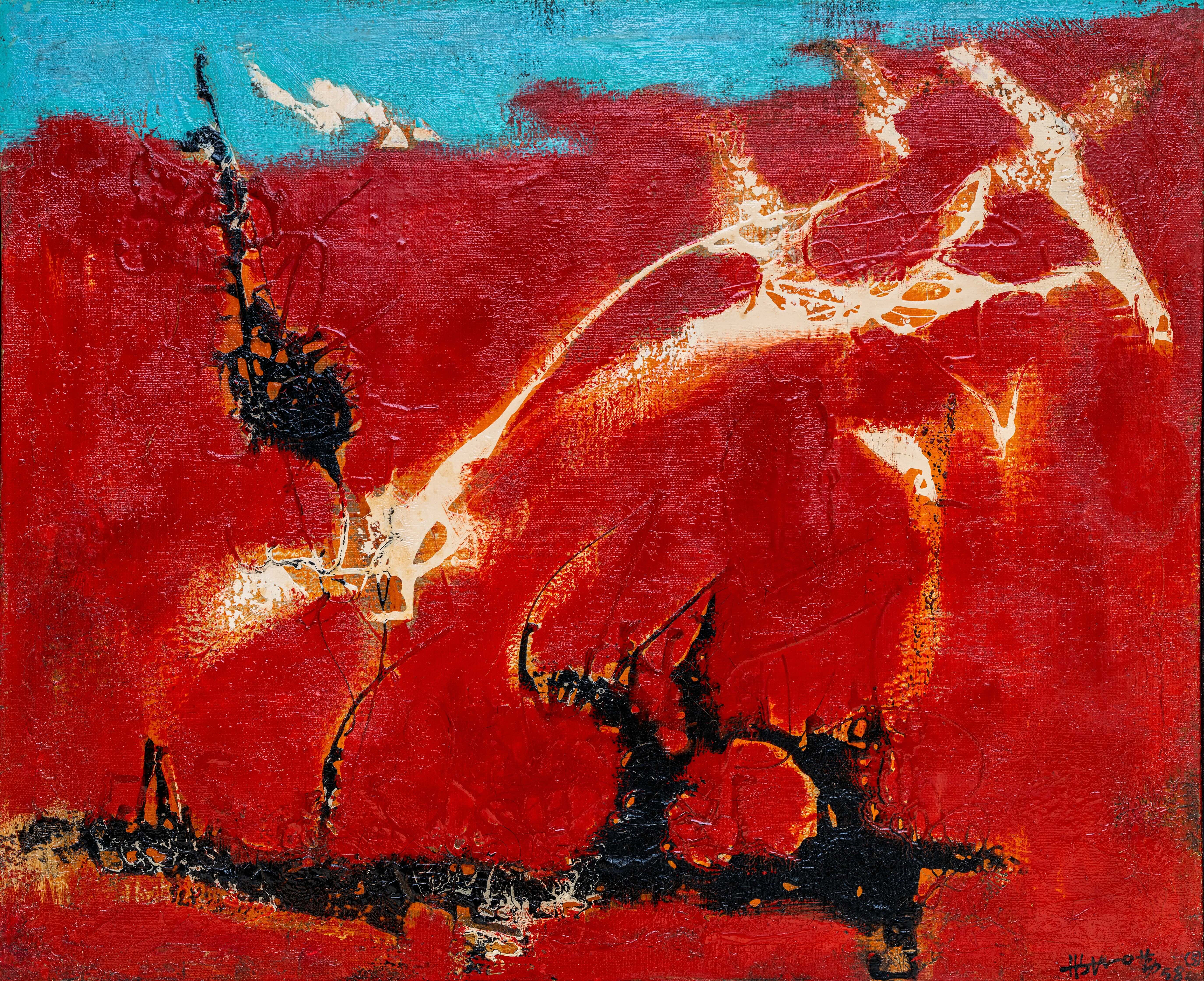 Hsiao Chin, Pintura 5, 1958, Oil on canvas, 50 x 60cm
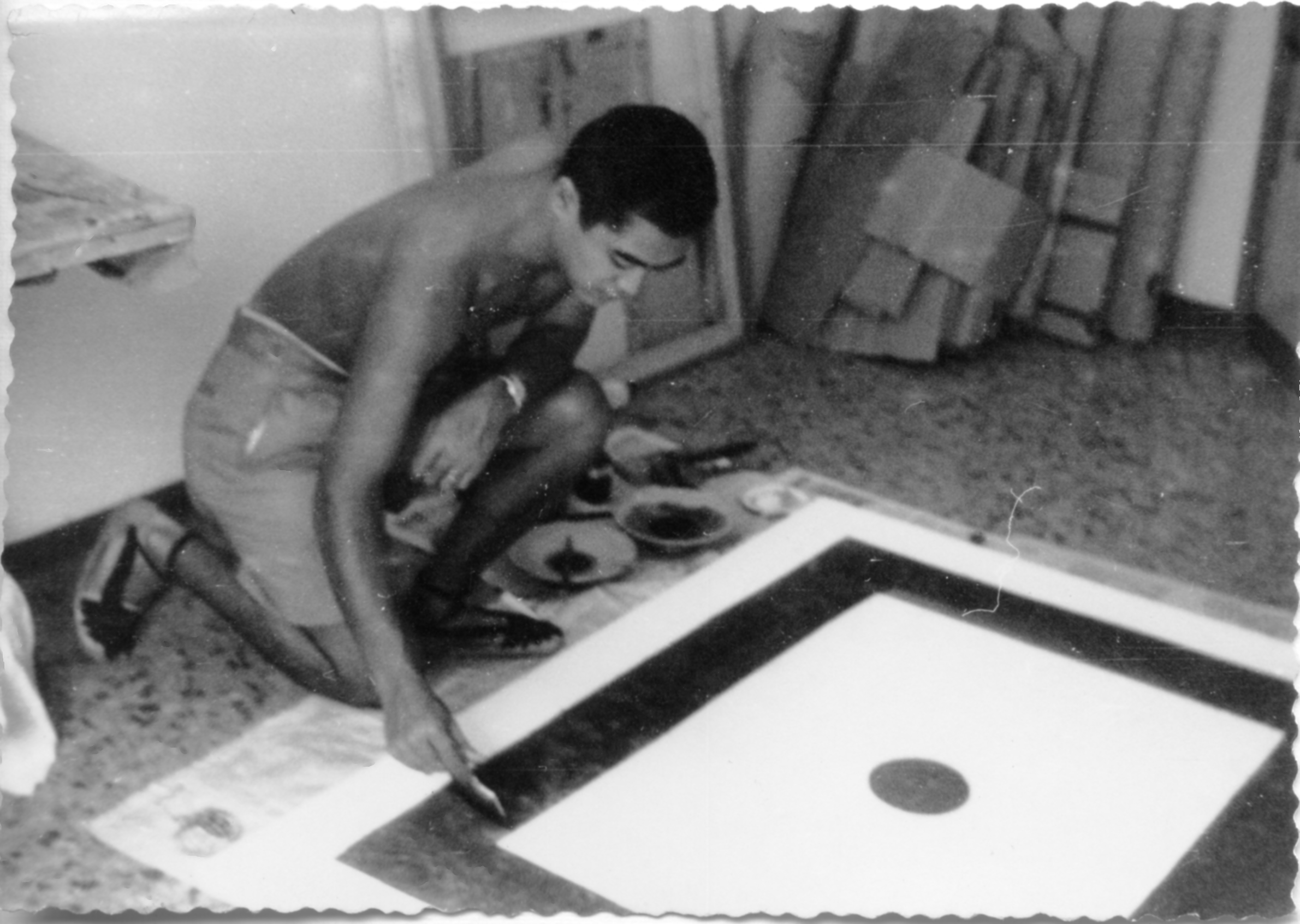
In 1961, he co-founded “Punto International Art Movement” in Milan with Antonio Calderara and others, bringing this exploration into a more explicitly international dialogue.[4] The point is both the simplest visual unit and a potential site of concentration, inception and unfolding. Within the finite space of a painting, how might a point generate relationships, a field of colour acquire depth, or an order accommodate the infinite? These formal questions became spiritual questions as well.
Hsiao thus entered the history of post-war geometric abstraction without stopping at geometry itself. Circles, axes and clearly defined colour fields are not merely structural devices in his work; they also redirect the viewer’s attention from the external world towards the act of seeing.
This orientation may be considered alongside modern art’s sustained exploration of inward experience. In Concerning the Spiritual in Art, Wassily Kandinsky examined the inner necessity of form and colour; in Interaction of Color, Josef Albers demonstrated the relational nature of colour perception; Calderara explored light and space through a restrained geometric vocabulary.[4][5][6] These comparisons do not suggest that Hsiao’s language can be explained through any one of these artists. Rather, they help clarify his distinctive position: he made the formal experiments of post-war abstraction a meeting place for Chinese cosmological thought, Buddhist reflection and personal experience.
Here, form is not an outer covering for spiritual content. Form itself is the means through which spiritual experience unfolds.
III. Inner Light: From Cosmic Order to Awareness
When light ceases to be merely an object of representation, it begins to address the consciousness of the viewer.
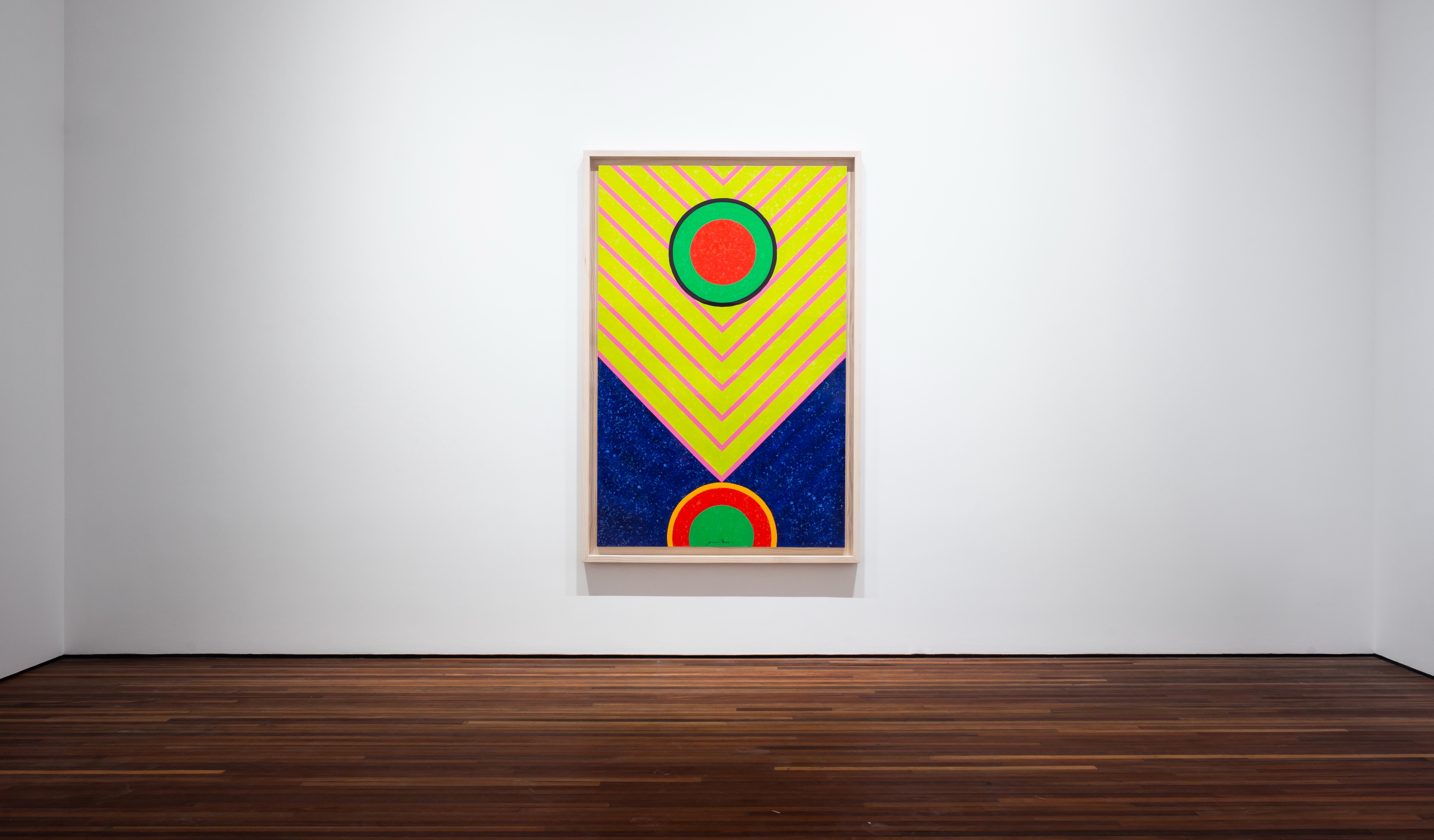
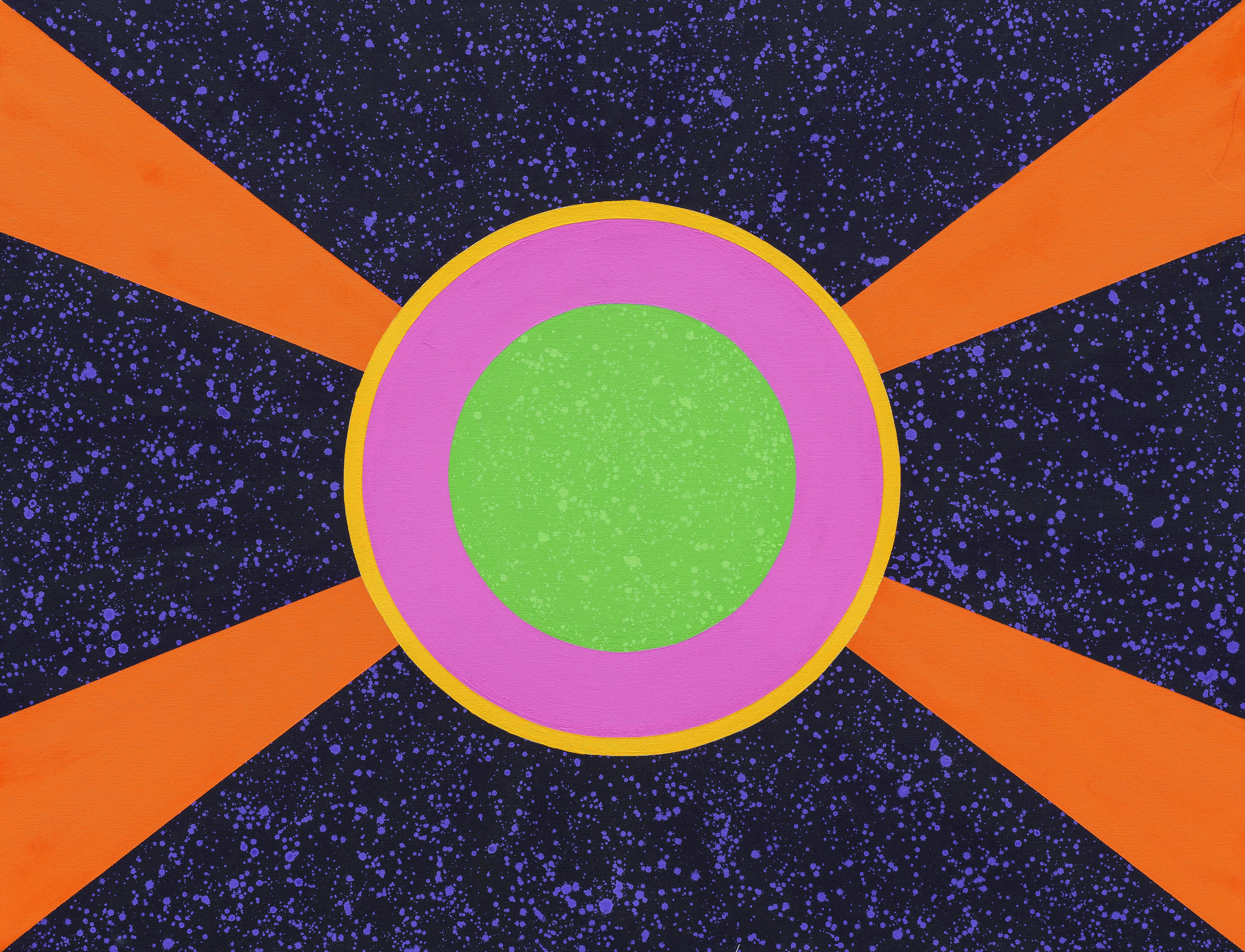
Light of Hope (1964), La Luce della Riflessione (1964), and Inner Light (1966) are pivotal works for understanding this shift. The Song Art Museum’s interpretations place both within Hsiao’s exploration of universal energy, emphasising relationships between circle and square, light and darkness, strength and restraint, against the background of Chinese cosmology and the thought of Laozi and Zhuangzi.[7] In these paintings, the circle may evoke a celestial body, but it also establishes a centre that gathers attention. The surrounding lines and colour fields connect that centre to a larger space.

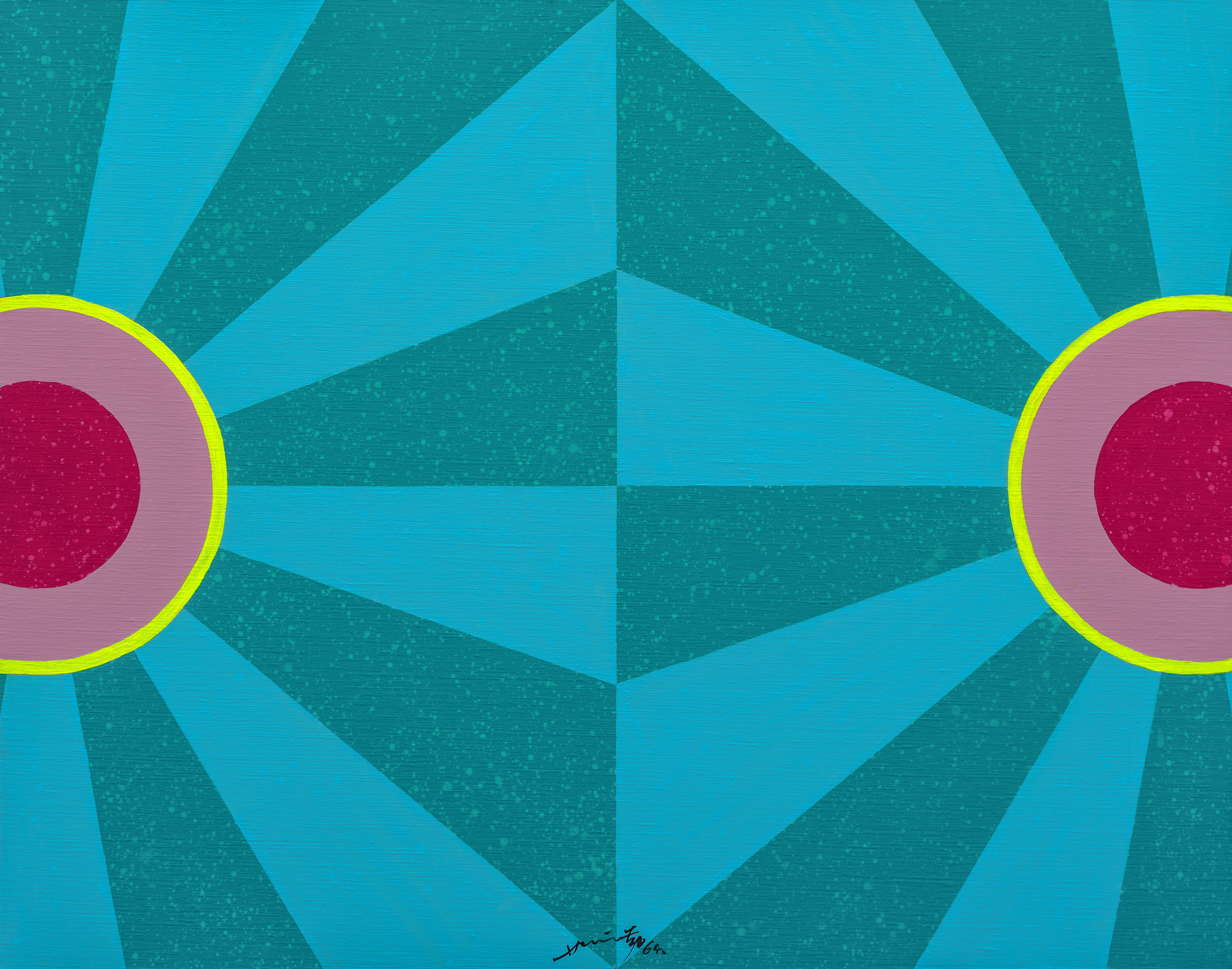
Light is therefore not an isolated point of brightness. It is the manifestation of a relationship.
Understanding this requires us to avoid subsuming Hsiao’s thought under an undifferentiated notion of “Eastern spirituality”. Daoist thoughts, Buddhist awareness and modern art’s exploration of inward experience intersect in his practice, but do not thereby become a single doctrine. A painting can accommodate the questions posed by different intellectual traditions without dissolving them into one answer.
Buddhist discussions of luminosity and awareness offer an important frame of reference. Passages concerning the “luminous mind” in the early Buddhist Aṅguttara Nikāya relate the mind’s clarity to the defilements that obscure it.[8] Light here does not describe a physical radiance within the body; it concerns the obscuring of the mind and the possibility of awareness. Nor should it be understood as an enduring, unchanging soul.
The Heart Sūtra’s teaching on emptiness offers a further perspective: existence is neither isolated nor self-sufficient; the significance of things arises through conditions and relationships.[9] Viewed through this interpretative lens, the intervals in Hsiao’s paintings are no longer merely absences. They allow forms to respond to one another, establish a reciprocal relationship between centre and periphery, and open finite structures towards a wider space.
These texts are not established as the direct sources of any particular painting. Rather, they provide an interpretative framework for understanding his spiritual orientation. Together, they suggest an important distinction: inner light is not a power through which the self takes possession of the world, but a possibility of easing the self’s obscurations and recognising relationships anew.
From this perspective, awareness extends beyond personal clarity. The “Universal Gateway” chapter of the Lotus Sūtra, devoted to Avalokiteśvara, connects images of light with wisdom, compassion and the response to suffering.[10] Light enables not only seeing, but also a response to the lives that are seen. Inwardness in Hsiao’s painting need not, therefore, imply withdrawal from the world. It may instead become the point of departure for returning to it.
IV. From Sacred Radiance to the Language of Abstraction
Buddhist art has given this invisible awareness a rich range of visual forms.
In Buddhist sculpture, mural painting and thangkas, halos, aureoles and the arrangements of colour surrounding a central figure do more than depict ordinary illumination. They signify sacred presence, direct the act of viewing and connect the principal image to a larger religious world. The geometric structures of thangkas, in particular, cannot simply be described as “abstract painting” in the modern sense: their forms generally belong to specific iconographic, ritual and contemplative systems.[11]
Yet this offers an important basis for comparison: spirituality may enter visual experience through centres, boundaries, repetition and relationships of colour, rather than through narrative alone.
Hsiao once spoke to me about the inspiration he found in the Potala Palace and thangka painting. Recalling this conversation allows us to acknowledge his personal engagement with Buddhist visual culture, while still distinguishing that engagement from a demonstrable source for any individual work.

Buddha of Medicine Bhaishajyaguru, ca. 1319, mural (water-based pigment on straw-tempered clay), 750 × 1510 cm
The Metropolitan Museum of Art collection
The mural Buddha of Medicine Bhaishajyaguru, dating to approximately 1319 and held by the Metropolitan Museum of Art, New York, offers an illuminating comparison.[12] The Buddha’s majestic figure and the sacred order surrounding it make radiance a means of organising the entire composition and suggesting spiritual presence. We cannot infer from this that the mural directly influenced Hsiao. The more defensible connection lies in a resonance between their visual operations.
Hsiao’s distinctive achievement was to bring this question of presence into post-war abstraction without requiring viewers to identify a deity or rely upon established religious imagery. A spiritual centre can be formed by a circle; radiance can be suggested through the expansion of colour; cosmic order can be apprehended through geometric relationships.
In this sense, he neither reduced Buddhist art to a formal resource nor turned modern abstraction into a substitute for religious imagery. His _paintings open a space between the two: the sacred is no longer borne exclusively by a represented figure, but may also emerge through the processes of looking and becoming aware.

Mark Rothko, Untitle, 1968, Acrylic on paper on board, 45.4 x 60.8cm
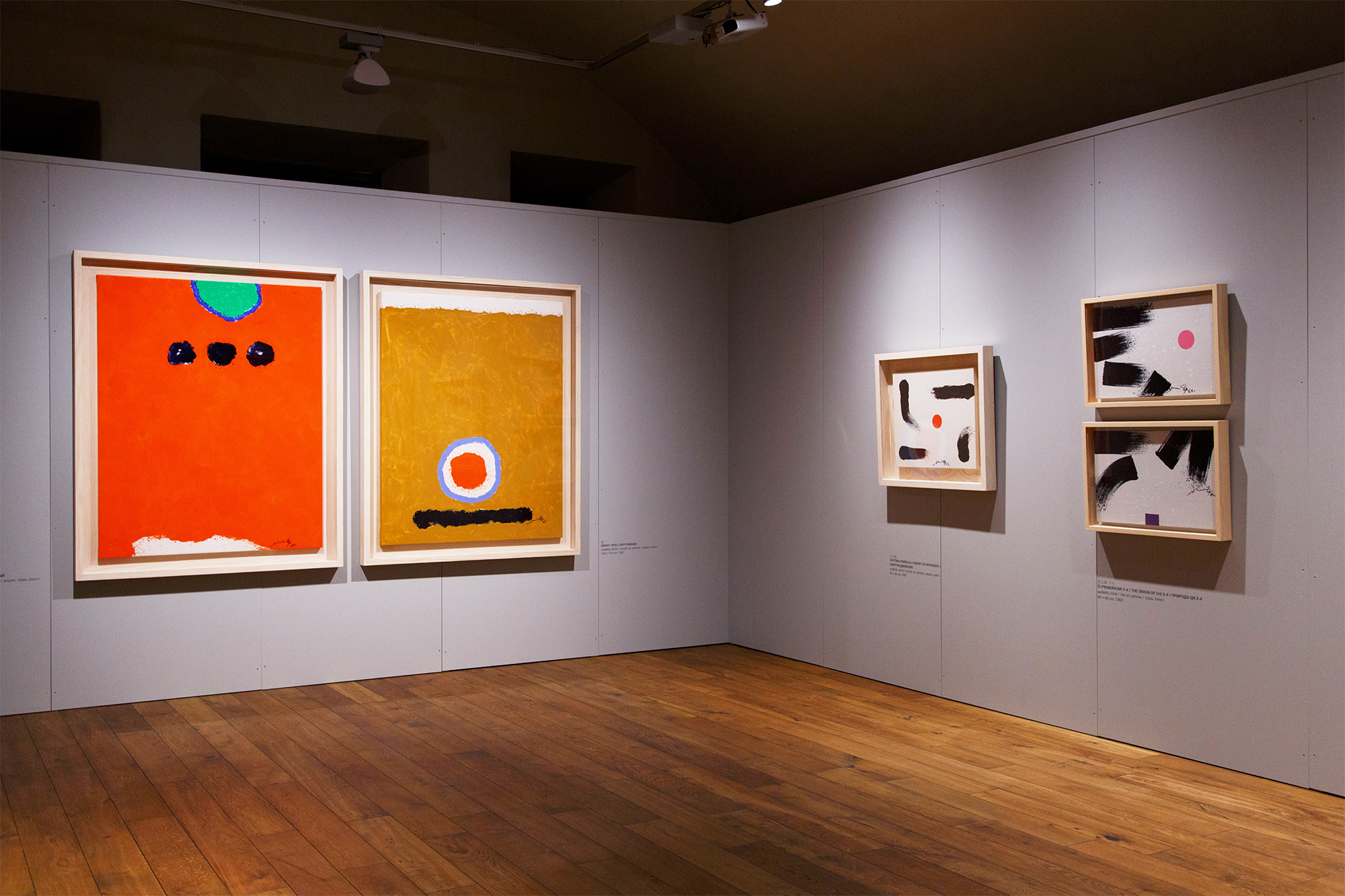
“In My Beginning Is My End: The Art of Hsiao Chin”, a retrospective curated by Philip Dodd, Rothko Museum, 2020
This also gives significance to his dialogue with Mark Rothko. Their formal languages and intellectual sources differ, but both artists move abstract painting beyond the recognition of objects, making it an experience that asks for time, sustained attention and emotional participation. Hsiao met Rothko in New York in 1968. In 2020, the retrospective “In My Beginning Is My End: The Art of Hsiao Chin”, curated by Philip Dodd at the Mark Rothko Art Centre (now named as “Rothko Museum”) in Latvia, offered a new historical setting for this dialogue.[3][13]
Light here is not merely a subject represented by painting. It is also painting’s capacity to transform the way we see.
V. “There Is No Darkness”: Light That Endures Through Loss
If light signifies awareness, however, that awareness cannot depend upon denying suffering.
Hsiao’s statement, “I have experienced a lot of darkness in my life, but the Heavens have given me the darkness so that I could understand where the light is. There is no darkness in this world, there is only light; it is up to us whether we see it.”, is best understood within the circumstances of his life, rather than as a facile dismissal of real pain.[14] For an artist who experienced childhood bereavement, migration, the death of his daughter and physical difficulties in later life, these words may be read as a spiritual position: a refusal to allow darkness to become the final definition of life.
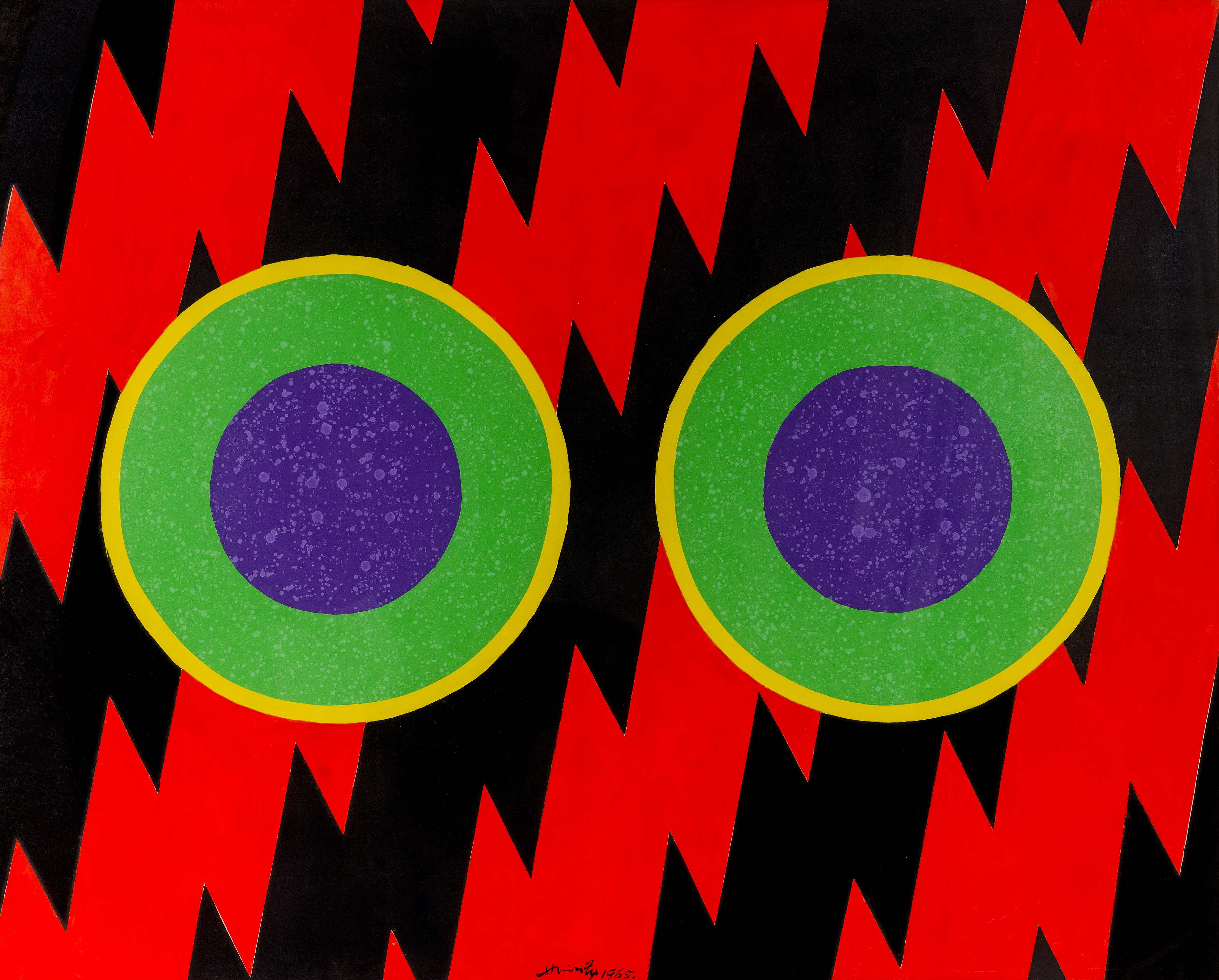
The titles In the Depth of Darkness (1965) and Inner Light (1966) suggest precisely this way of reading his work. They need not establish a simple opposition between light and dark. Inner light does not have to wait for the external world to become bright. It may signify that, even amid uncertainty, the possibilities of awareness and connection have not been entirely extinguished.
The death of his daughter Samantha in 1990 transformed this question from philosophical reflection into an intimate reality. The subsequent “Eternal Garden” paintings and works concerned with the transcendence of life do not erase loss. Instead, they seek another expression for a love that can no longer continue in its former way.
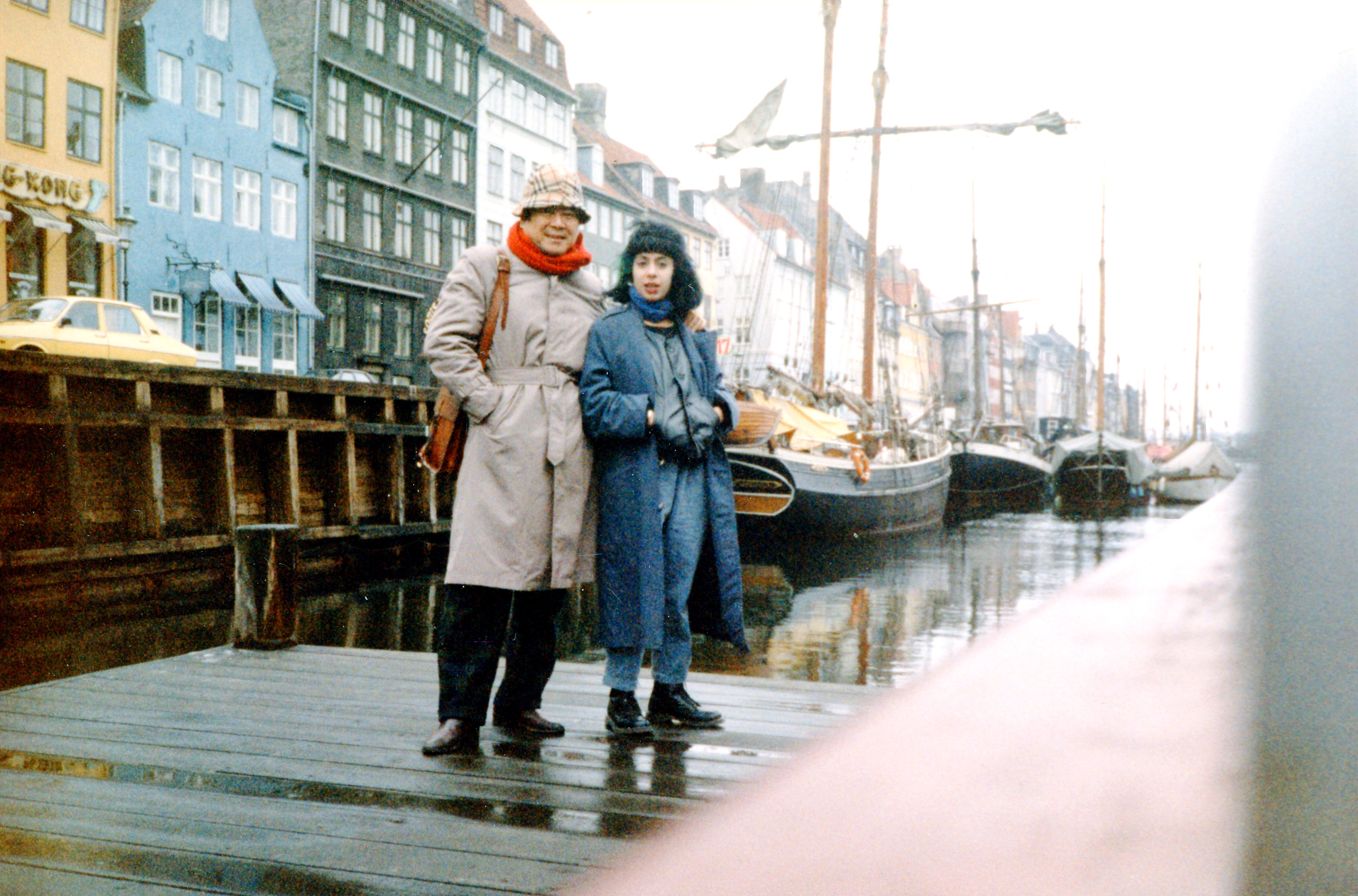
Hsiao Chin with his daughter Samantha in Copenhagen, 1986
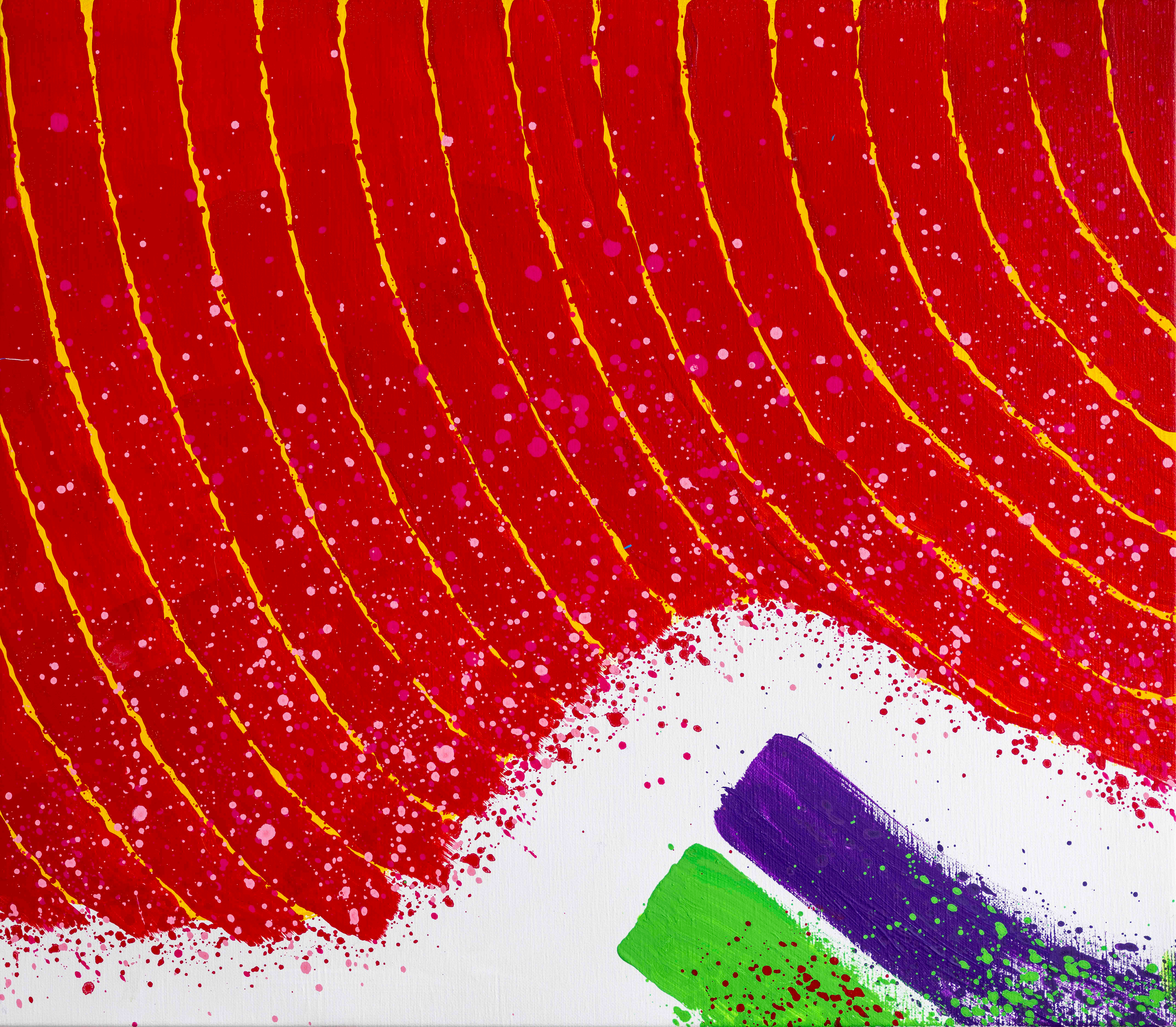
Hsiao explained that, through rich colour, he created a series of eternal gardens for his daughter, places where she might wander and rest. These paintings embodied the prayers and blessings he wished to offer her.[3] In the same published account, he described how reflection on life after death led him to understand that “the end is the beginning”, and that the energy of life does not cease with death.[3]
Such statements should first be respected as the artist’s personal convictions, rather than as religious conclusions that viewers are required to accept. Their significance lies in what they made possible: painting became a means through which he could continue to love.
Speaking of his daughter, Hsiao once said: “There is no death, but just non-presence”.[15] Quiet yet profound, these words distinguish her absence from the enduring presence of love. No longer being able to see one another does not mean that a relationship has ceased to exist. Seen in the light of this personal recollection, the colours of the Eternal Garden paintings are more than memories of the past. They offer a continuing companionship: through painting, he created a place where his daughter could wander and rest, allowing love, even after loss, to retain a place it could reach.
The garden is not simply a depicted location. It is a space established through love, a gift that can still be offered in the midst of absence. Private grief thus gradually becomes an experience that others may enter. Viewers need not know every detail of his biography to sense the paintings’ responses to loss, memory and continuity.
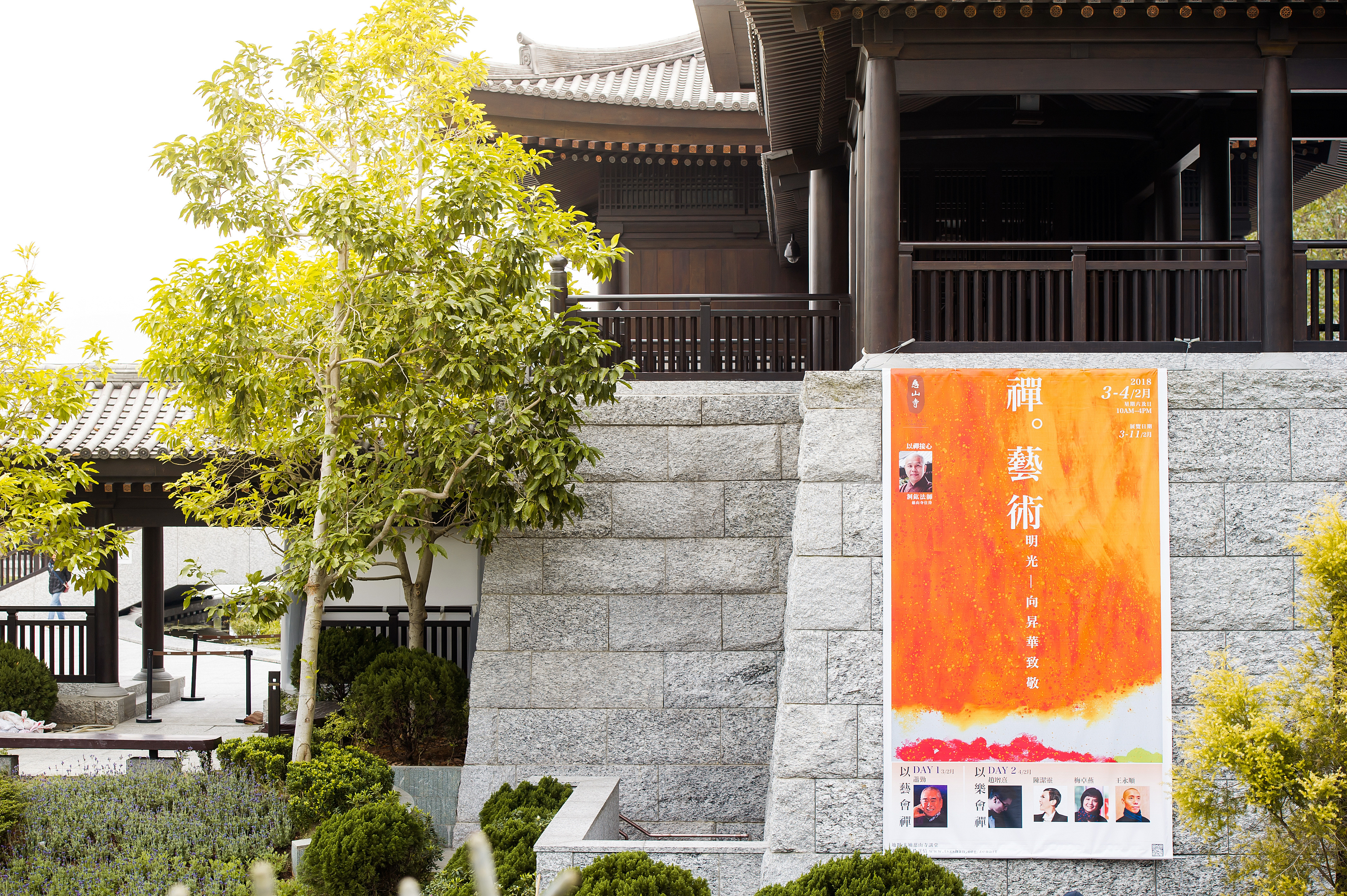
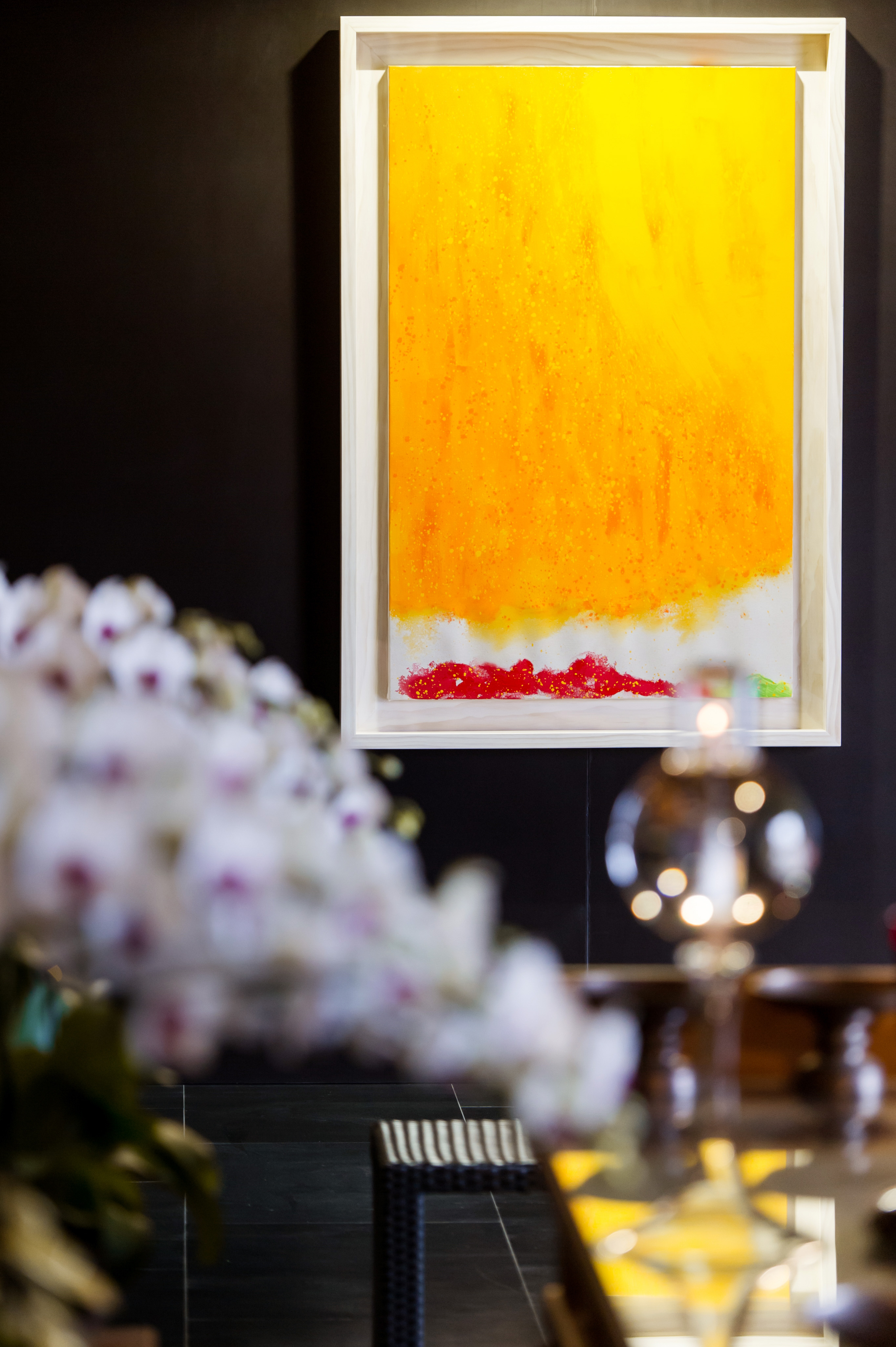
In 2018, Tsz Shan Monastery collaborated with 3812 Gallery to present a solo exhibition of Hsiao Chin, "ZEN。ART". Bright Light—Homage to Ascendence (1990) was exhibited as the centrepiece of the exhibition in the Universal Gate Hall at Tsz Shan Monastery
Bright Light—Homage to Ascendence (1990) belongs to this pivotal year.[16] Its title brings light into relation with homage, transformation and transcendence. Yet the painting should not be reduced to an illustration of a particular event. Biography gives painting depth, but cannot exhaust its meaning.
Hsiao’s spiritual transcendence does not, here, mean leaving the human world behind. It means finding forms through which love within that world may continue. Light possesses its power precisely because it does not bypass pain. It passes through pain and becomes a blessing.
VI. From One Person’s Light to Hope for the World
When light can carry a blessing, it no longer belongs to an isolated individual.
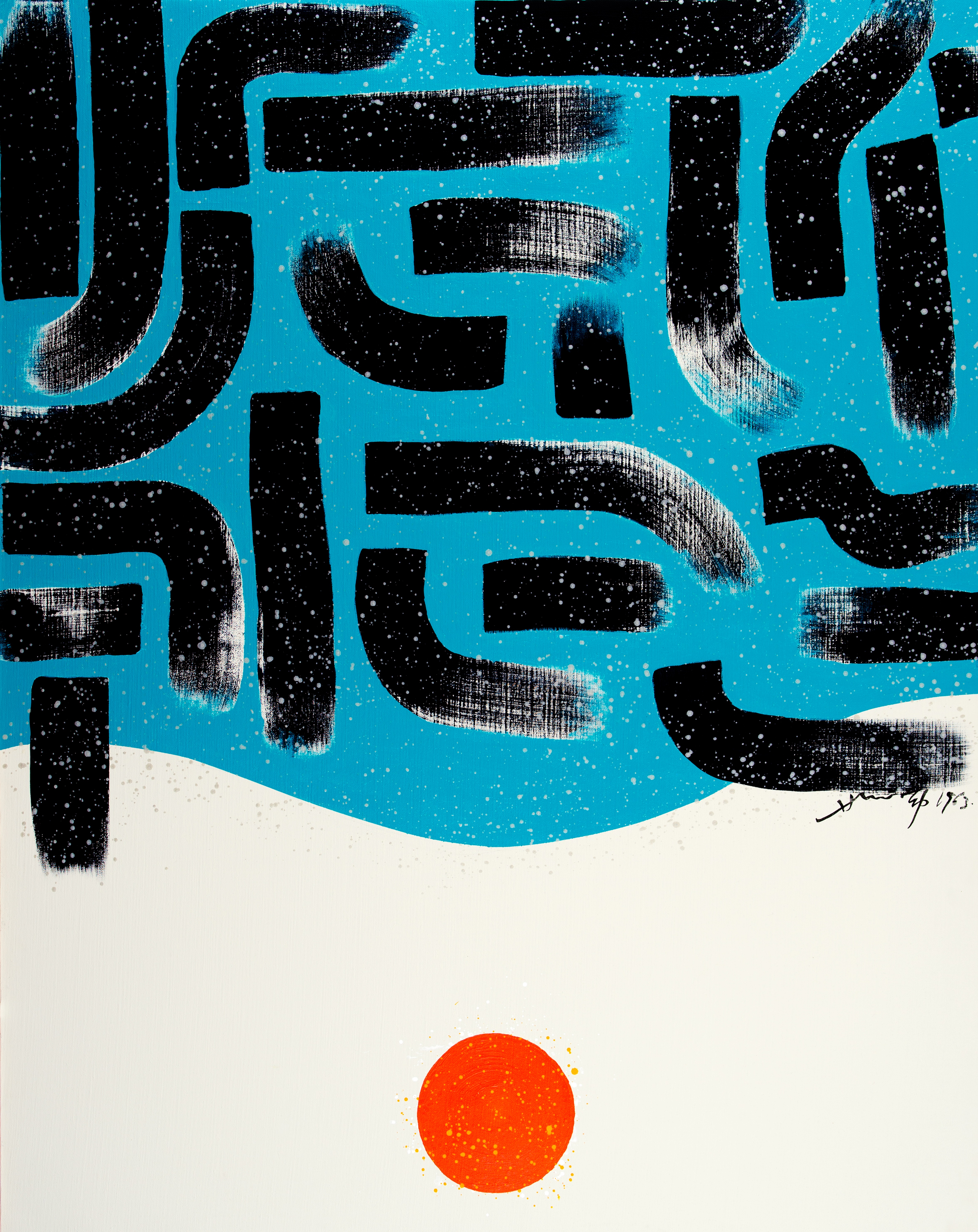
Hsiao Chin, Dancing Light-15, 1963, Acrylic on canvas, 140 x 110cm
Guggenheim Abu Dhabi Collection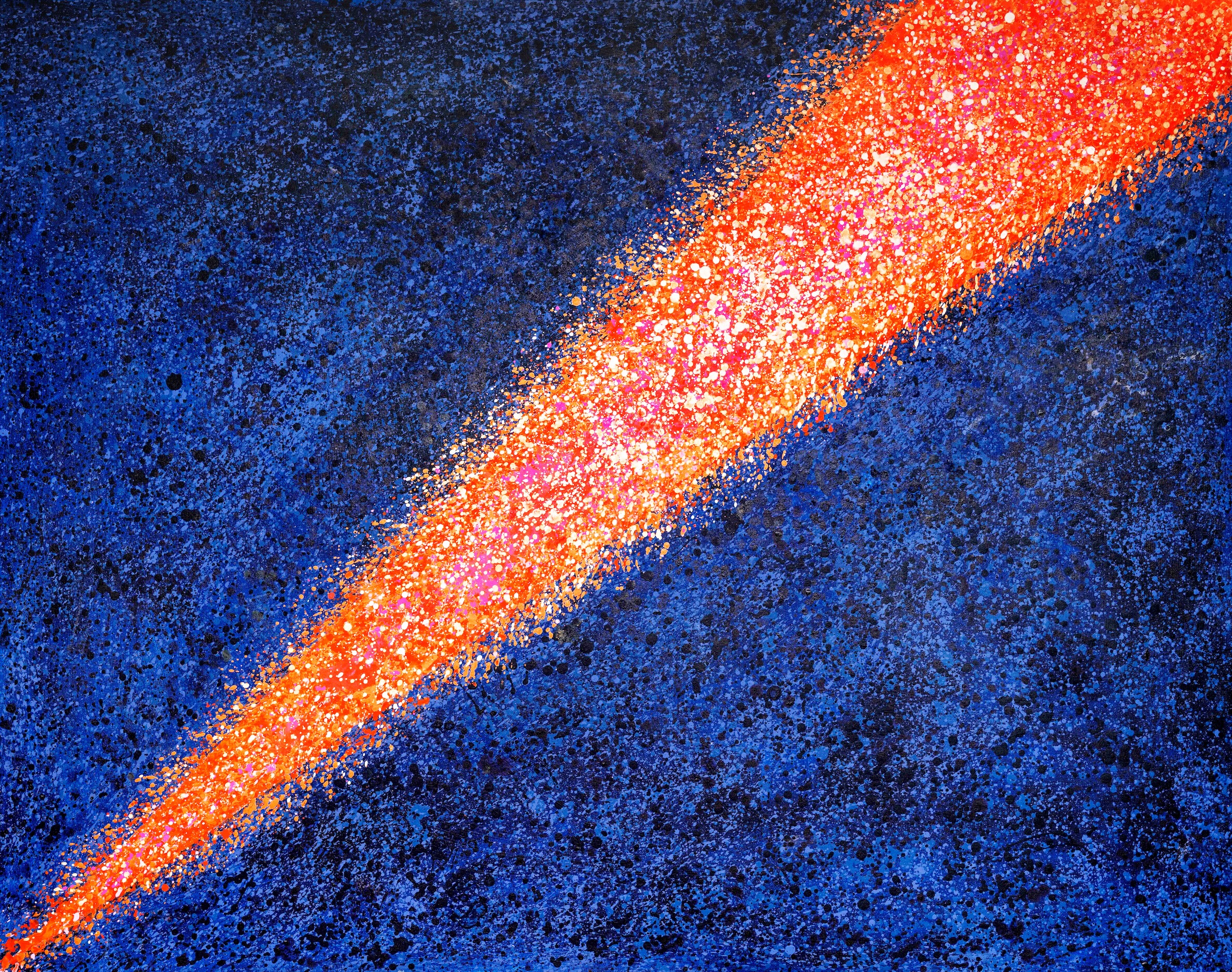
The titles Dancing Light, La Luce della Riflessione, and Universe Light lead inward illumination towards movement, expansion and sharing. Light is no longer only a stable centre; it becomes a responsiveness between the individual and the wider world. The universe does not displace intimate feeling. On the contrary, love for one person gradually opens towards concern for many lives.
A work from the “Dancing Light” series entered the Guggenheim Abu Dhabi collection in 2025. This institutional context offers a further setting in which to consider Hsiao’s exploration of light within an international history of abstraction.
Hsiao Chin’s Hope-1 and Hope-2, created in 2021, were exhibited in the solo exhibition "The Light of Hope – Hsiao Chin 90th Anniversary Retrospective Exhibition" at the Guangdong Museum of Art (Bai’etan), 2025
His late paintings Hope-1 and Hope-2, both created in 2021, can be understood against the shared vulnerability brought about by the COVID-19 pandemic. These were the only two Hope paintings he made in response to the pandemic. [17] At a time when isolation, loss and uncertainty had become global experiences, hope was not a promise that suffering would soon disappear. It was an insistence that suffering did not constitute the entirety of life. Through these works, his longstanding reflection on life’s continuity extended from personal experience towards a shared human condition.
This reading also bears upon his physical circumstances in later life. Painting cannot demonstrate that illness may be overcome through spiritual will. What it can reveal is that, even when the body is constrained, creation, care and generosity may continue. The meaning of light thus shifts from “How may I find consolation?” to “What may I still give to the world?”
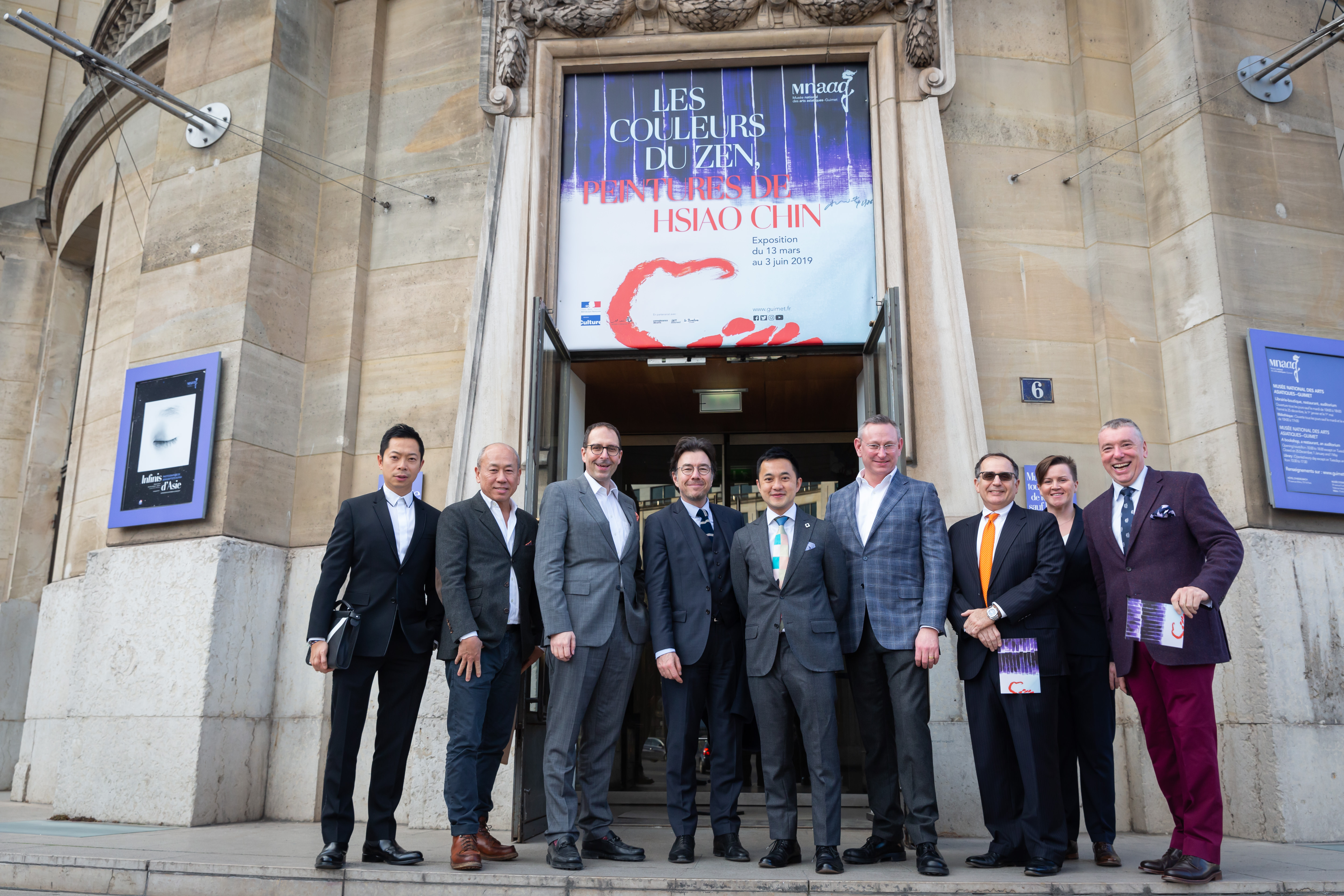
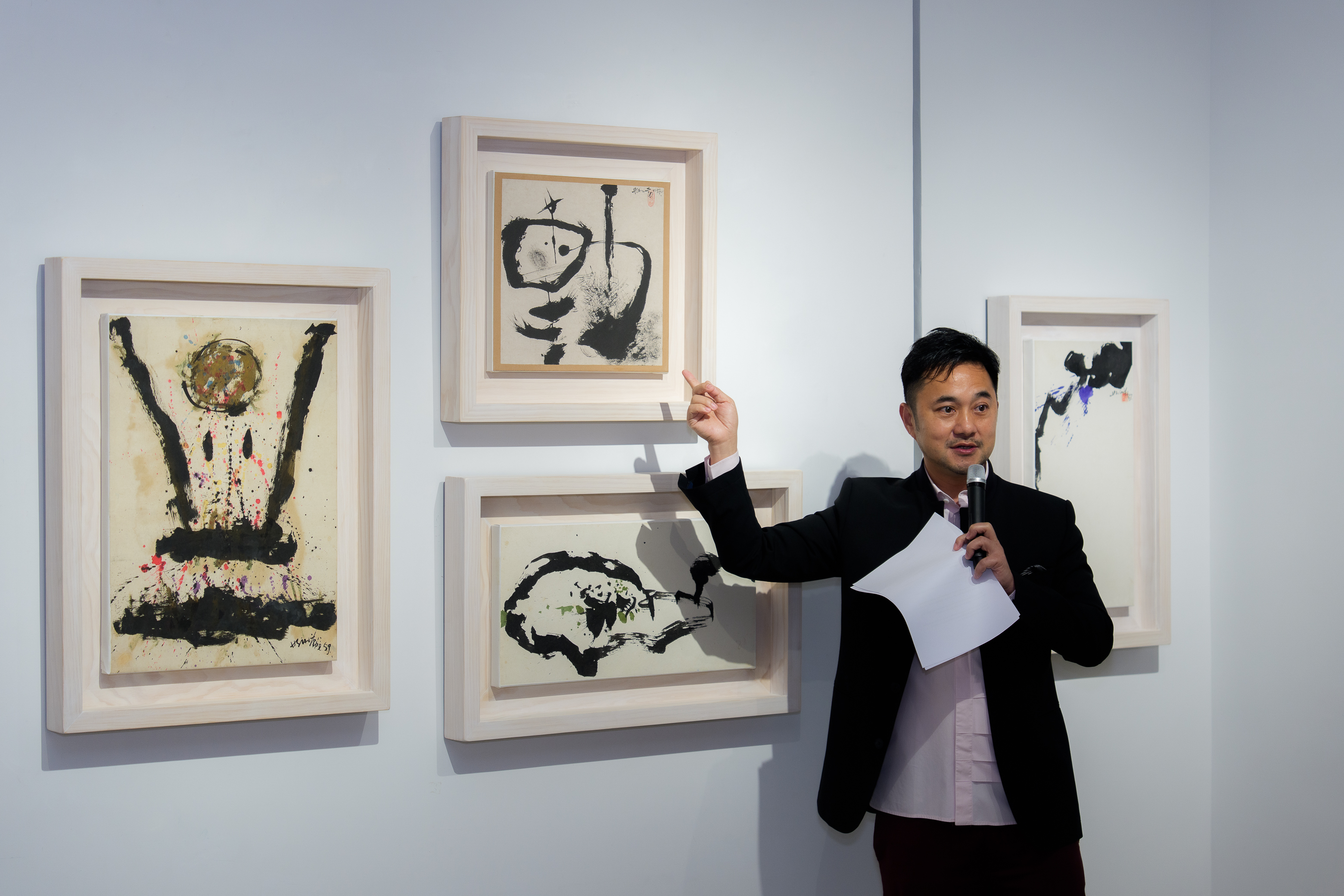
Musée Guimet, Paris, presented Hsiao Chin’s solo exhibition "The Colours of Ch’an" (Les Couleurs du zen). Calvin Hui (centre), Mark Peaker (far right) and others at the opening, 2019
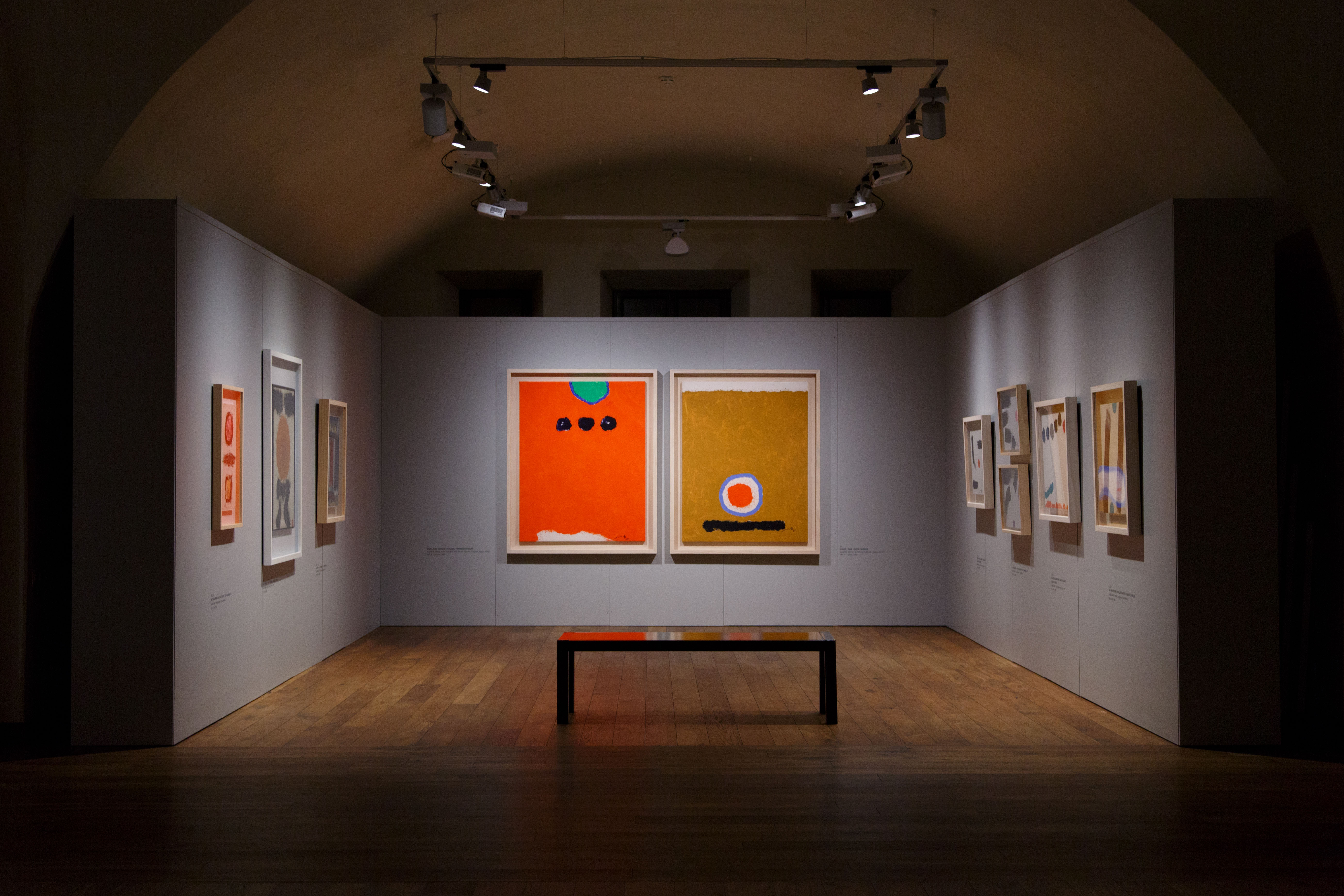
His solo exhibition at the Musée Guimet in France in 2019, followed by the retrospective at the Mark Rothko Art Centre in 2020 (postponed to 2021 due to Covid-19), provided important institutional frameworks for viewing this decades-long exploration.[3][8][18]. Recent auction interest in Inner Light, In the Depth of Darkness and Pintura 5 also suggests that his work is reaching new publics.[19][20][21] Changes in price, however, cannot substitute for art-historical judgement, nor should they become the endpoint of this journey of light. Meaningful reassessment depends upon the sustained understanding established through research, archival work, exhibitions and collecting.
Hsiao’s historical contribution was not simply to introduce a particular “Eastern philosophy” into Western abstraction. Working within the international field of post-war art, he created a language capable of accommodating cosmic order, inward awareness and compassion for human life. The light that runs through this language does not always take the same form. At one moment, it is concentration and expansion within a geometric structure; at another, the reciprocal presence of light and darkness. It becomes a garden created for his daughter in grief, and eventually a hope opened towards others.
It does not ask us to believe that darkness has never existed. It invites us to believe that darkness does not have the final word.
This is the human significance of Hsiao Chin’s journey of light. Light is not a state of purity removed from life. It is the capacity, at life’s most vulnerable points, to remain aware, to sustain love and to offer that love to the world.
Author’s Afterword
As my gallery’s representative artist, curator of his exhibitions, and a close friend in his later years, I will always remember that day. On the open sea beyond Kaohsiung Harbour, following the direction illuminated by his thought, I bade a final farewell to the artist who had been both my teacher and my friend. In accordance with his wishes, I scattered his ashes into the sea, setting him free to continue his journey back to Sirius. On the return voyage, a colourful butterfly appeared on deck. A little girl whom Hsiao cherished pointed to it and said, “Laoshi is here”. In that moment, her words resonated deeply within me, and I heard anew what he had once said: “There is no death, but just non-presence”. Today, as I return to his paintings and reflect upon the time we shared, I feel more deeply the light he gave us. It remains not only in his works, but also in our encounters, our companionship and our farewells, continuing to illuminate our connection with the world.
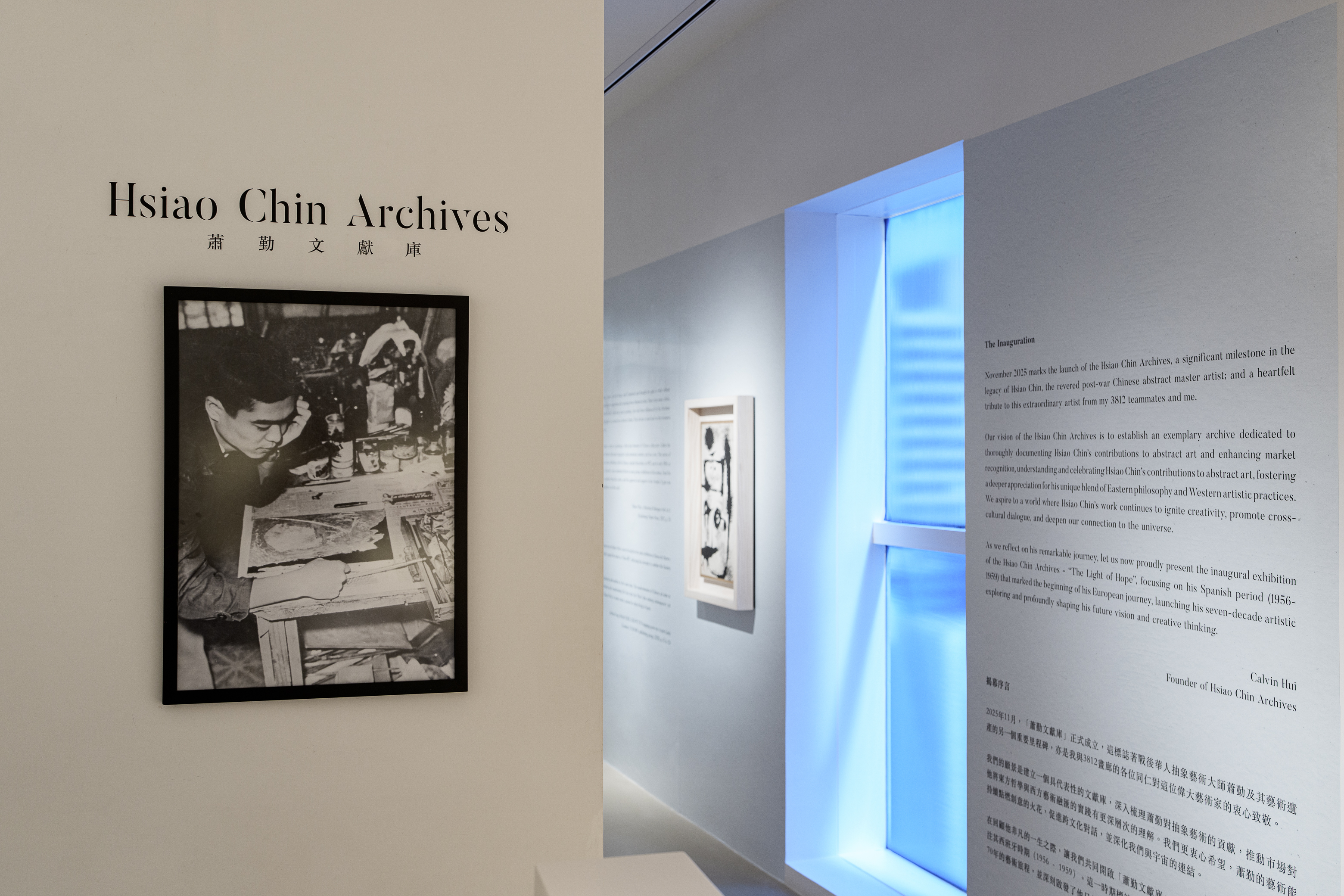
On the first anniversary of the establishment of the Hsiao Chin Archive, I offer this essay in tribute to Hsiao Chin—artist, teacher and dear friend.
References and Sources:
[1] Eugene Hecht, Optics, 5th ed. Pearson, 2017. Cited for the scientific background to visible light, materials and visual perception, not as evidence for the artist’s spiritual propositions.
[2] Song Art Museum: The Artist as Astronaut: Hsiao Chin, 2017, Beijing, p. 15. Hsiao Chin, Grand Energy of the Universe.
[3] Punto Press: Legend of the Rambling King: Side View of Hsiao Chin, 2018, Kaohsiung, P. 32–54.
[4] Ocula / Gió Marconi, Hsiao Chin artist biography. Cited for his years in Spain and Milan, the Punto movement and subsequent developments in his practice.
[5] Wassily Kandinsky, Concerning the Spiritual in Art, translated by M. T. H. Sadler. London: Constable, 1914.
[6] Josef Albers, Interaction of Color. New Haven: Yale University Press, 1963.
[7]Song Art Museum: The Artist as Astronaut: Hsiao Chin, 2017, Beijing, P. 40.
[8] Aṅguttara Nikāya, Book of the Ones, passages concerning the luminous mind, commonly numbered AN 1.49–52; numbering varies between editions. See Bhikkhu Bodhi, translator, The Numerical Discourses of the Buddha. Boston: Wisdom Publications, 2012.
[9] Prajñāpāramitāhṛdaya, or Heart Sūtra. Scholarly reference: Donald S. Lopez Jr., The Heart Sūtra Explained: Indian and Tibetan Commentaries. Albany: State University of New York Press, 1988.
[10] Lotus Sūtra, “The Universal Gateway of the Bodhisattva Avalokiteśvara” chapter. English translation consulted: Burton Watson, translator, The Lotus Sutra. New York: Columbia University Press, 1993.
[11] Sotheby’s, “Hsiao Chin, Mark Rothko, and the ‘Not Only, But Also’ Art of Unity,” interview with Philip Dodd, 29 June 2020.
[12] 3812 Gallery: From Eternal Garden to the Bright Side – Hsiao Chin Memorial Exhibition in Hong Kong, 2024, Hong Kong, P. 51.
[13] David P. Jackson and Janice A. Jackson, Tibetan Thangka Painting: Methods and Materials. London: Serindia Publications, 1984.
[14] Metropolitan Museum of Art, New York, Buddha of Medicine Bhaishajyaguru, China, approximately 1319, mural, collection record. Cited comparatively. Accession Number: 65.29.2.
[15] 3812 Gallery: From Eternal Garden to the Bright Side – Hsiao Chin Memorial Exhibition in Hong Kong, 2024, Hong Kong, P. 7.
[16] Tsz Shan Monastery: “ZEN。ART” Exhibition Catalogue, 2018, Hong Kong, P. 20–21.
[17] The Online Magazine Meer, “Illuminated heart”, 11 April 2026. The article discusses 3812 Gallery London’s exhibition “Illuminated Heart”, referring to works from Hsiao Chin’s “Hope” series, Universal Light (2003), and the collection of Guggenheim Abu Dhabi.
[18] Musée Guimet, Paris: Hsiao Chin: The Colours of Ch'an (Les Couleurs du Zen: Peintures de Hsiao Chin), Paris, 2019.
[19] Phillips, London auction-results press release, 26 June 2026. Records Inner Light (1966) at a reported sale price of £516,000, against an estimate of £80,000–120,000. Phillips official website link: https://www.phillips.com/press/release/david-hockney-leads-phillips-london-sale-of-modern-contemporary-art
[20] HENI News, “Bonhams Modern & Contemporary Art Auction Totals $1.34m,” 1 June 2026. Reports the sale of In the Depth of Darkness(1965) at Bonhams, Hong Kong, on 31 May 2026. Bonhams official website link: https://www.bonhams.com/zh-hk/auction/32070/lot/6/hsiao-chin-1935-2023-in-the-depth-of-darkness-nel-profondo-delle-tenebre/
[21] HENI News, “Hsiao Chin Work Sells for $419,600 to Deliver a 40% Annualized Return,” 21 October 2026. Reports the sale of Pintura 5(1958) at Phillips, Paris. Phillips official website link: https://www.phillips.com/detail/蕭勤/241913

