
3812 Gallery: Your art clearly embodies the qualities of naturalism, with flora taking centre stage and textures unfolding in veined, curled forms brimming with vitality. And how does naturalistic expression shape or contribute to the narrative you wish to convey?
Thomas Ngan (TN): Naturalism was my starting point because it’s a universal language, one that does not require education or context to be understood. In the beginning, learning to depict things realistically was necessary; it gave me all the tools to communicate clearly. But as the work developed, I found myself branching into other territories. It applies to both realism and abstraction to me – they are different vocabularies but the same system.
3812: The girl – or sleeping-beauty-like figure – foregrounded in several of your paintings evokes John Everett Millais’s Ophelia, where the figure is gently enveloped by natural elements that both frame and humanise the scene. Do you draw inspiration from Millais’s “maximum realism” or the pathos of his approach to life? And what particular emotional resonance or pathos do you hope to convey through the placement of your characters and the way you ornament the natural environment around them?
TN: I’ve seen Millais’s paintings, but I can’t say they directly shaped my work in any conscious way. For me, the figure is closer to a kind of quiet funeral, a space where a part of us can be allowed to die so something better can begin, in many ways it’s like a baptism.
However, I want the figure to hold many emotions at once. Portraits shouldn’t be fixed; they should shift with each viewing, revealing different things to different people. The surrounding natural elements aren’t just decoration. They echo that inner transition, holding the figure gently while pointing toward something higher. Ultimately, the figure is a representation of things beyond the visible, the same way we are.

Thomas Ngan, The Path, 2025, Oil on canvas, 71.1 x 152.4cm
3812: While Naturalism emerged in the 19th century as a counterpoint to Romanticism – rejecting its idealised and dramatic tendencies – there is no denying that your work carries distinct Romanticist undertones. The misty, veiled light cascading across dream-toned leaves, and the gentle glow brushed onto the cheeks of your female figures, transport viewers into a sublimely utopian realm.
Do you intentionally weave Romanticism into your naturalistic depictions, allowing the two seemingly contrasting approaches to coexist? Or does this fusion arise organically as you work?
TN: Naturalism may have rejected Romanticism’s idealisation, but it still carried its own form of idealisation, just expressed differently. In practice, the distance between the two isn’t as wide as it appears, they both rely on heightened perception, and both pursue something beyond ordinary sight. Their technical foundations are almost identical.
So I don’t consciously combine them, but the Romantic tone appears because of how I see the world. The mist, the softened light, the stillness – they come naturally when I try to paint what feels true internally.
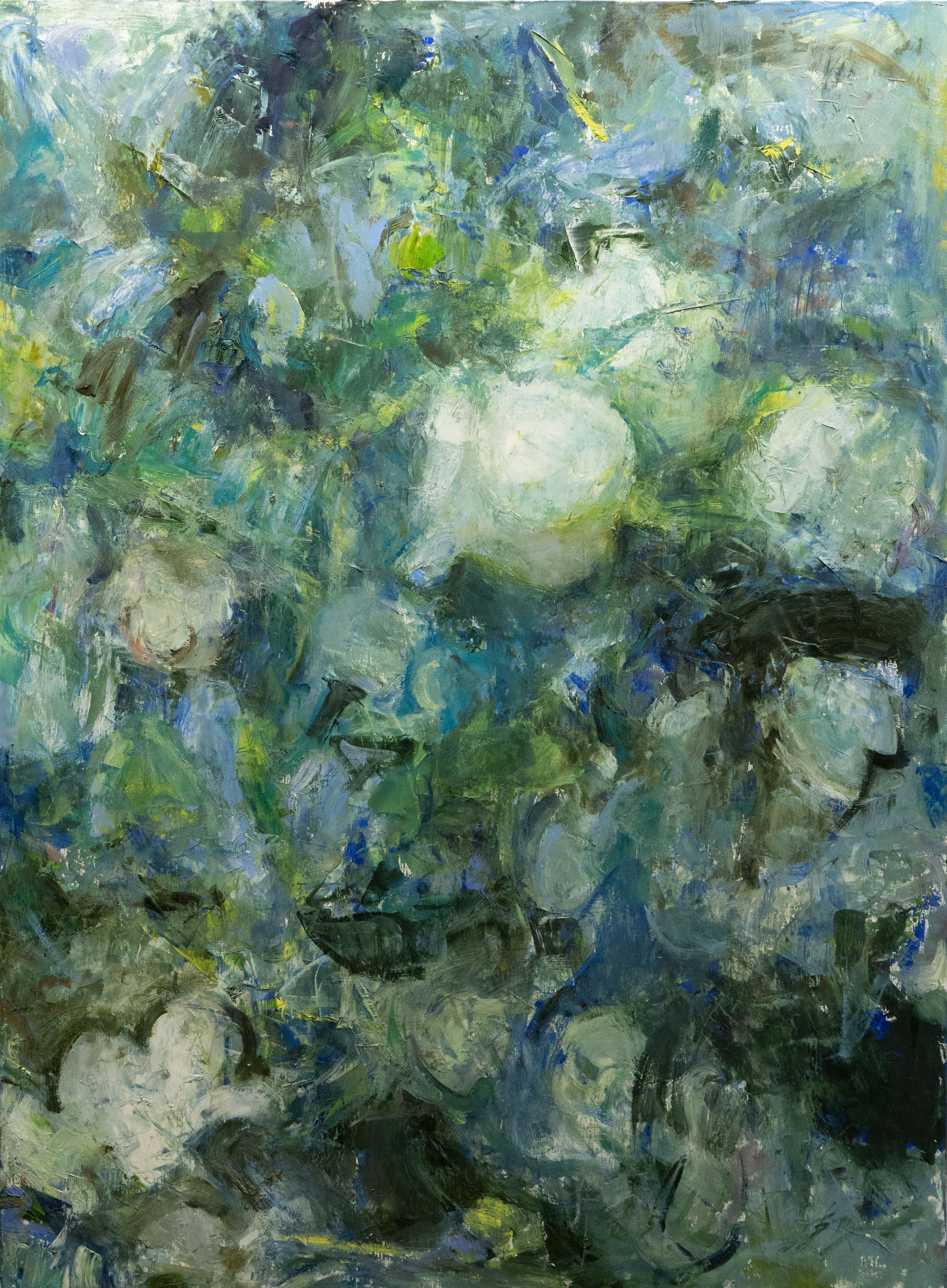
Thomas Ngan, Marsh, 2025, Oil on canvas , 96.5 x 71.1cm
3812: The figures in your paintings often appear suspended between wakefulness and dreaming, almost like conduits between the physical world and something more interior or transcendent. What draws you to depict the human figure in this liminal state, and what emotional or symbolic purpose does it serve in your visual language?
TN: I’m drawn to that space between waking and dreaming because, as we age, life itself starts to feel like it moves through a kind of haze. I’m not trying to tell a personal story through the figure, yet it inevitably becomes personal; people will always create their own narrative.
Like the flora, the figure is a vessel. It lets me speak about renewal, surrender, and quiet contemplation. When a body is at rest, its defences fall away. It becomes unguarded, honest – and in that honesty, worthy of tenderness.
3812: Your most recent works show a noticeable shift, with the female figure receding into obscurity or becoming less visually foregrounded. Is this part of an intentional narrative progression? What story arc or thematic direction is leading this change?
TN: I will skip this question for now because I think the more mystery the better for this instance.
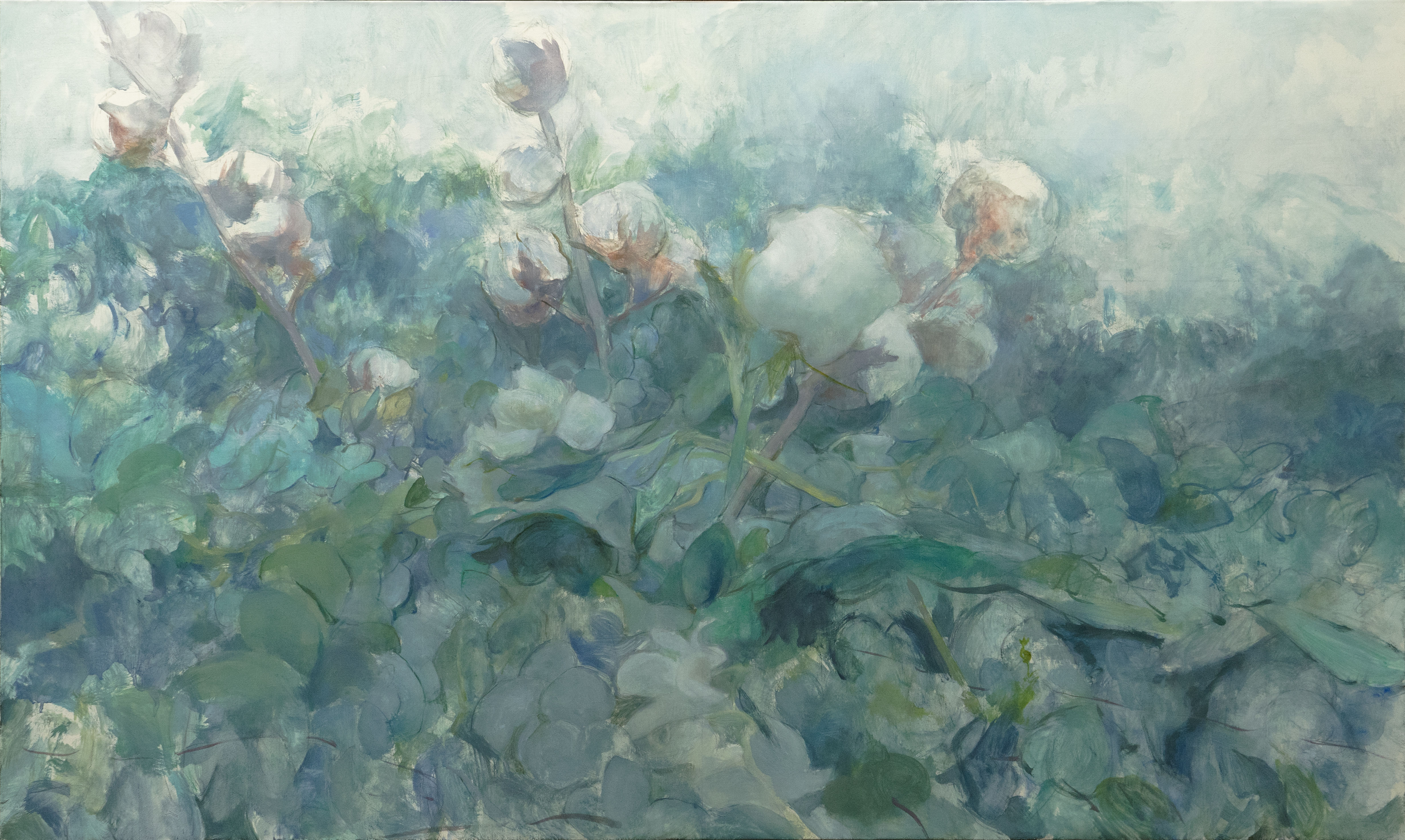
Thomas Ngan, Ruach, 2025, Oil on canvas, 61.0 x 101.6cm
3812: How do you interpret the rise of contemporary abstract art, which often prioritises conceptual ideas over the direct depiction of recognisable subjects? While your work may be loosely situated within this broader movement, tangible subjects remain a constant presence in your practice. Do you see your art as occupying a liminal space – in narrative, expression, tropes, or technique – between abstraction and representation?
TN: The rise of contemporary abstraction feels inevitable to me, because the real strength of art isn’t in reproducing what is already visible. When something is truly majestic or beyond comprehension, it can’t be contained by direct depiction. Christ spoke of heaven in parables for the same reason – we need a symbolic language to approach what cannot be grasped literally.
Art functions in that same space. Abstraction becomes a kind of parable for the unseen. I’m always testing where the boundary sits – how far I can push with all these different pathways and styles, while still keeping the communication intact. I want the paintings to offer enough grounding for viewers to explore the work, while also giving them space to interpret, reflect, and bring their own understanding into the narrative.

Thomas Ngan, Heritage, 2025, Oil on canvas, 142.2 x 91.4cm
3812: Have you ever felt lost in your artistic pursuit when searching for the visual vocabulary to express the “unseen”? Or have you encountered moments when the unseen landscape feels almost impossible to grasp? How do you break those bottlenecks and what enables you to stay continuously in the flow of creation?
TN: I have never painted a painting worth painting that is about the painting itself. I hardly encounter any difficulties about what to express when I’m painting – once I start, it flows. The real struggle is when I don’t feel like painting at all. Those are the bottlenecks of life, not from art. Painting often feels like trying to unravel everything that’s happening in my life, like a diary, where I try to understand it all through painting. To no avail, yet voila, a painting is done.
3812: Since embarking on your artistic journey with 3812 Gallery, you have quickly risen to prominence as a leading figure among the new generation of emerging artists – showcased through two solo exhibitions in 2023-2024 at our Hong Kong gallery and at Art Central, as well as your participation in this year’s group exhibition “Dreamscape” and The Treasure House Fair 2024 in London.
How do you tangibly grow and flourish under 3812 Gallery’s ongoing gesture of support and endorsement toward young artists and their creativity? In what ways do your artistic ethos and conceptual pursuits align with, or complement, the gallery’s curatorial vision?
TN: They are wonderful people. Their support has given me the space, time, and stability to paint as much as I do. That trust allows me to take risks, challenge my ideas, and keep developing my visual language without feeling the pressure to conform to trends.In many ways, my practice aligns naturally with their curatorial vision. The gallery is committed to presenting work that carries both technical integrity and conceptual depth, and that resonates with my own pursuit – exploring perception, constructing the world view, and the quiet spaces between seen and unseen. They never dictate direction. Instead, they give me the room to advance at my own pace, while offering guidance, opportunities, and a platform that helps the work find its right audience.
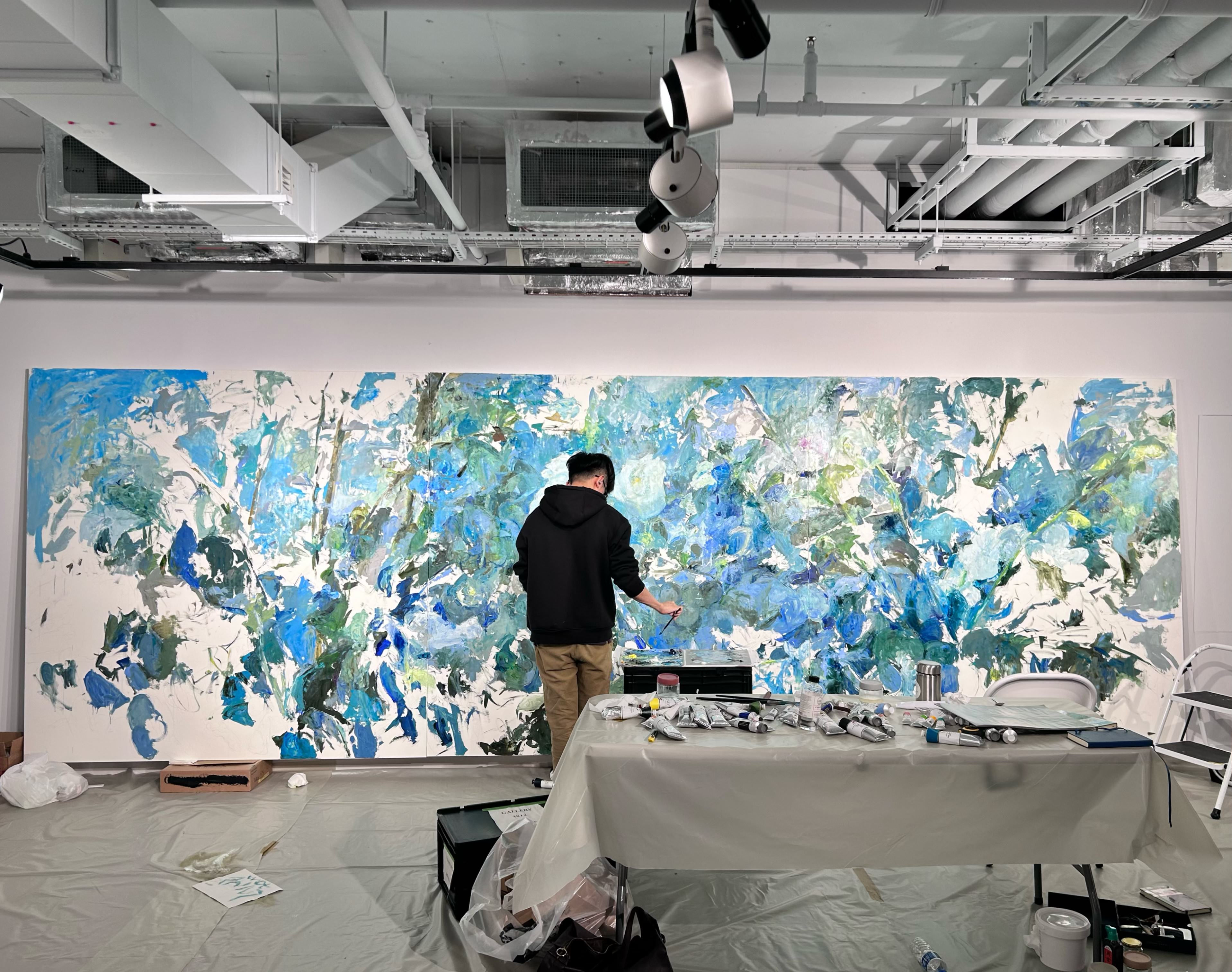
Thomas Ngan is in the process of creating a 6-metre-long painting
during his artist residency at the 3812 London Gallery.
3812: As the first young artist to inaugurate our London gallery’s residency, what message or impression are you hoping to convey in setting the tone for a programme that will become a fixture of our London gallery?
TN: When Calvin proposed the residency, I asked him, “Is it ambition that you want?” He said, “Yes.” So that’s what I hope to set in motion – an atmosphere of sincerity, courage, and possibility. If this programme is to become a fixture for future artists, I hope this first step shows that ambition, when paired with honesty and craft, can lead somewhere meaningful.

