Katie Hill (hereafter referred to as Hill): Stanley, it's been a pleasure to get to know your work a little more in the past few months and to meet you in person. I've been mulling over many questions about how to tie various themes together and explore its aesthetic and philosophical threads. I'd like to delve into some ideas and talk about your first London solo exhibition here at 3812 and what it means to you.
What were you doing when you first came to London?
Stanley Wong (hereafter referred to as Wong): My first time in London was the winter of 1988, walking in Hyde Park, which is still one of my most favourite places in the world. Calm nature, tall trees, geese, historical insights, art and culture on the intellectual front. Observing cavalry practice there, gentlemen and ladies walking across to work, lovers, families, runners, and even elderly people swimming in the club in the freezing winter — it's an ideal universe by itself.
London to me was eye-opening through art. As an ad agency, art-based creative (and graphic design as a hobby), experiencing classical, modern, and contemporary art was my curiosity and my way of learning about the possibilities of visual creation. Of course, as I became more and more engaged, I started appreciating and valuing the spectrum of artistic intentions and the power of artists' voices.
I kept circling information in my Time Out magazine, going to all kinds of big and small art events and exhibitions non-stop: Saatchi Gallery, Tate Britain, the V&A, Hayward Gallery, The Photographers' Gallery, the ICA (Institute of Contemporary Arts), Whitechapel Gallery, the National Portrait Gallery, Design Museum, RCA (Royal College of Art) grad show … and many more.
I also enjoyed the hip, trendy, and creative places, such as Soho for fashion and gay and lesbian culture, Covent Garden, Lloyd's Building, Portobello Market, Tower Records, Camden Town for second-hand stuff — and once, dancing in Club Heaven till six in the morning (that was the early 90s).
Hill: You mentioned fond memories of various museums and colleges you connected with through your encounters. How important is this city to your development as a designer and artist?
Wong: In the late 80s and early 90s, creativity in London was 360 degrees — woven from art, design, architecture, advertising, music, street fashion, and musicals — from the old to the new, to the avant-garde. I grew up with all these influences beyond my very commercial Hong Kong advertising world.
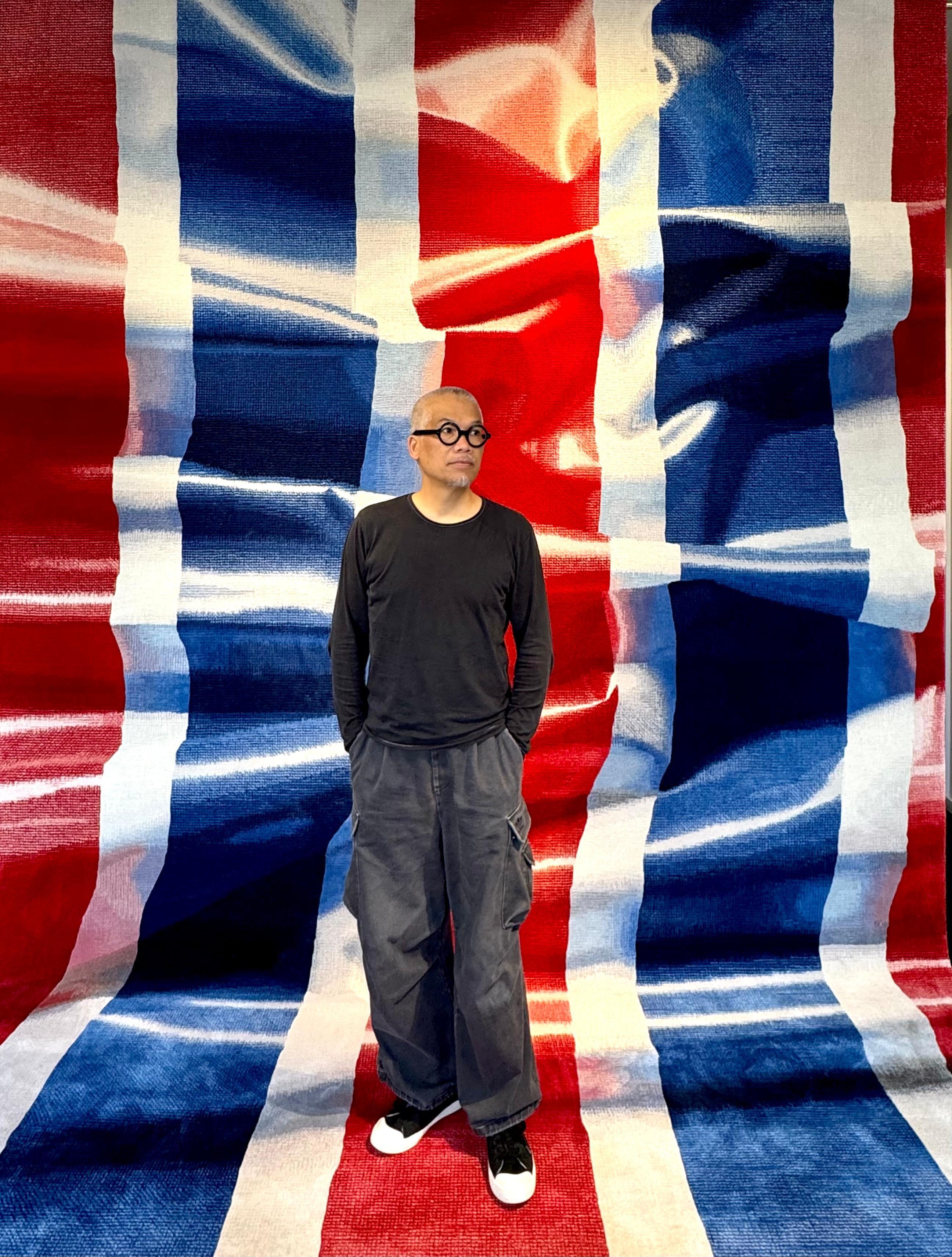
Stanley Wong stands on his iconic artwork hong kong walk on _ one
anothermountainman, hong kong walk on _ one, 2022, Hand tufted wool and silk rug,
600 x 300cm
Hill: How do you think it plays a role in Hong Kong culture as a whole?
Wong: In Hong Kong's commercial creative world of the 80s to early 90s, we were admiring the West. London exported a strong influence to Hong Kong in many ways — not only through the colonial relationship. The London phenomenon and its creative ideology gave me courage and confidence, and subconsciously set another bar for myself.
From the incident I encountered in Soho, a hip, small boutique selling a very down-to-earth Hong Kong daily object, the "red-white-blue" plastic bag. I was awakened and reminded of the uniqueness and power of “local culture” and "local relevance" from a communication point of view.
I went to London to absorb the infinite creative possibilities, yet it was like a mirror reflecting who I am — a Chinese from the East.
Visual Language
Hill: I feel that you have developed several distinct languages in your work over the decades.
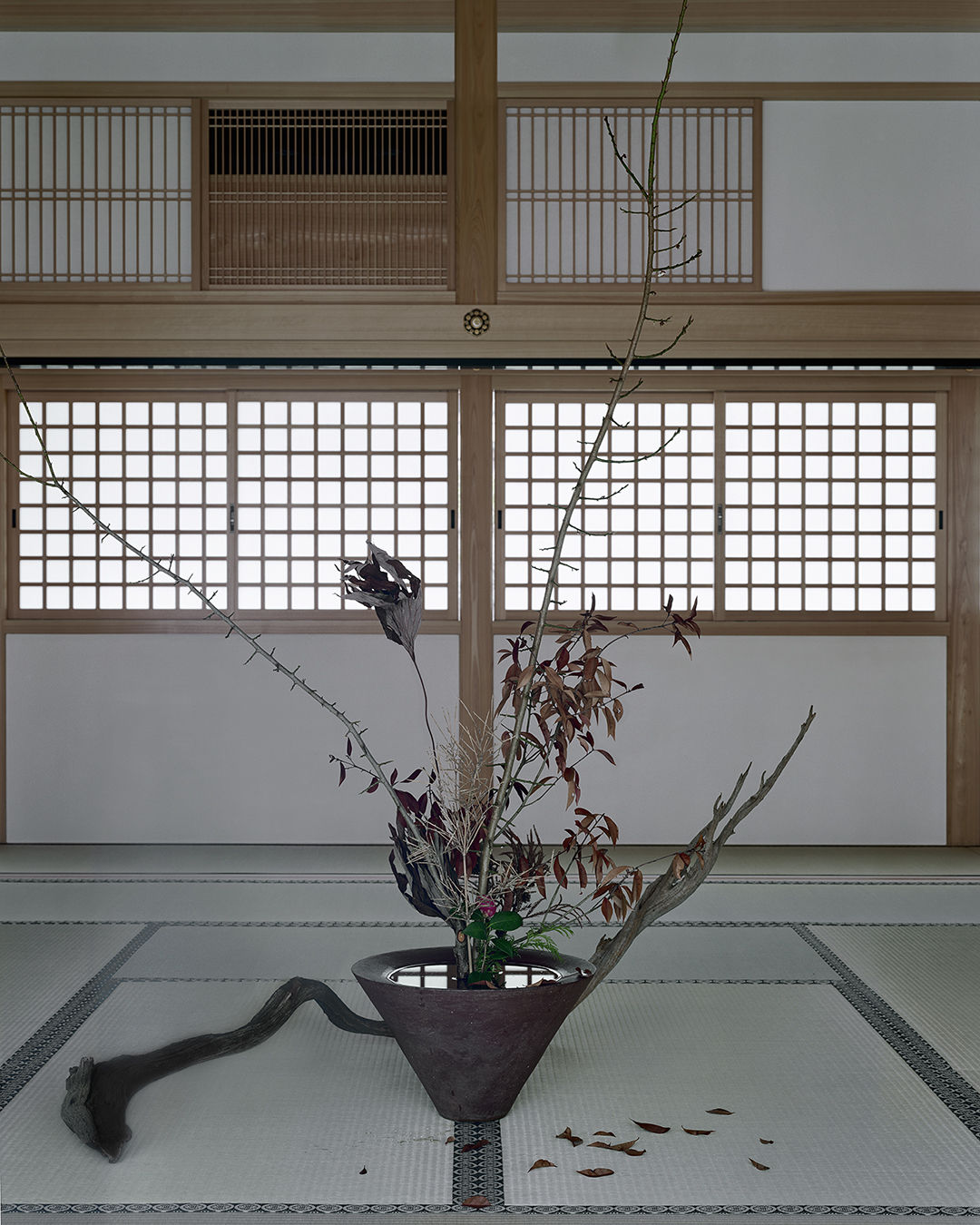
The visual rigour of graphic design and design thinking seems to flow through your works and aesthetics via the careful framing of the visual plane compositionally and the viewer’s receptive relationship to images. I see this in in the "lanwei" series, the "i see ikebana. they are ikebana." series and the photography works set in landscapes. Another language is shanshui, whereby elements of nature are drawn out within a much longer tradition of classical literati culture from China. As "anothermountainman", clearly there is an overt reference to the Qing painter Bada Shanren in your artistic identity, and you have explored mountains within many different contexts in your work.
The formality of the vertical scroll arrangement of your photography also appears to respond to certain visual patterns in Chinese painterly traditions and it would make sense that you draw on this as well.
To return to graphic design/advertising, I was looking at "No Matter What You're Looking for. Take MTR", the campaign for the MTR, which is a very interesting conceptual design using a kind of word search technique, to provoke the public's response to ideas of travel in Hong Kong.
Could you talk a little about the design language you developed in the earlier stages and secondly, how that is integrated into your visual thinking and later works?
Wong: For my first ten years, my design language was surely influenced by the West, including UK visual style and aesthetic trends, like Wong Kar-wai's Chungking Express and Fallen Angels film posters, singers' album cover design…
After my encounter with the "red-white-blue" bag in a hip boutique in Soho, London, during my work trip in the winter of 1988, I completely shifted my perspective of "way of communications" to "local relevance" and to a more "humanistic" approach in my graphic and advertising works — particularly during the four and a half years I worked in the Mass Transit Railway (MTR) Corporation. The audiences were the mass public — everyone in Hong Kong — so a "going style" approach was not workable. Therefore, I went local and spoke the language (of the city), using Chinese colloquial writing craft, visual metaphors, and devices drawn from daily life. All of these worked well simply because of empathy and the fact that we shared the same language and cultural context.
You have noticed the top and bottom blank white space in my photo presentation. I have started this from "lanwei" as my first conceptual photography solo show. Audiences and friends were suspicious and teasing me that I wasted the paper. After all, when people see more and more same format in my work presentations, they could subconsciously tell, anothermountainman carries an Asian / Chinese spirit, in which, that’s who I am.
Regarding visual language and composition, I am a big fan of the late master filmmaker Yasujirō Ozu, who has had a huge influence on me — looking at things and people on a parallel, frontal level: equal, respectful, sincere, and direct…

anothermountainman, lanwei 04 _ fly away _ guangzhou, 2006 Archival inkjet print,
139 x 111cm _ 114 x 91cm
Visual Weaving of Cultural Fabric
Hill: We cannot leave out the central aspect of your public recognition in connection with Hong Kong through the red-blue-white that defines your visual identity in the resonance of the ubiquitous bag fabric (I have some in my garage!) associated with carrying belongings and border crossings. I feel this is a kind of deconstructed interpretation of an everyday object, in the way that other artists have taken certain iconography, reinterpreted and transformed it (I am thinking of Michael Lin's rural flower motif in his large-scale visual installations, for example, or Ai Weiwei's porcelain sunflower seeds or the Coca Cola logo on the ancient Chinese pot). We live surrounded by signs, and the perpetual proliferation of image reproduction following Walter Benjamin’s seminal The Work of Art in the Age of Mechanical Reproduction in the early 20th century, has dominated modern life, now drastically speeded up through the technologies of streaming and most recently AI.
The simplicity of this work is what makes it so effective, and you counter-monumentalise it in some way, as a celebration of something we see but also do not see, as it surrounds us and is embedded in design culture for ordinary things used in everyday life.
What interests me now, is how this installation work can move from one object or form to another and manifest in numerous sizes, as small or large in a constant dialogue with material, architecture and environment. It has a special kind of mobility and adaptability. I’d like to think of it also as a contemporary form of Daoism, whereby the spirit resides in everyday things, however lowly or invisible. Do you think this is fair?
Wong: Let me answer you in this way, as I always always discuss the topic of "seeing" with students, youngsters, or photographers:
People said, taking a picture is not by the camera (lens), it is captured by eyes first… then I would add on top: your eyes see it because your heart sees it.
Seeing from heart. It is a fundamental learning and practice in life.
Eyes see thing(s).
Heart sees values, or value-less.
Eyes see existence.
Heart sees real yet illusion.
anothermountainman, reborn ikebana_01, 2011 Archival inkjet print,
Print size_ 37.5 x 30cm
Hill: I remember the brilliant artist Huang Yongping talked about this in relation to Chan Buddhism as well, crossing over with Daoist notions of 'thingness' (we might say ontology) in his early conceptual work. This is also the case in Shintoism, whereby the spirit resides in all things.
How do you feel about this? I know you have actively engaged with these philosophies in your work and there seems to be a movement in China and elsewhere towards a deeper philosophical reflection by artists, reaching for a more profound intellectual and spiritual understanding of the world around us, which has become very overwhelming and often frightening. We can turn back to this idea later on as well…
Wong: Nothing is concrete or absolute. Things are just perceptions. It is just a reflection of viewer's mind and heart.
Hill: From my perspective, your work seems to answer to the great W. J.T Mitchell’s idea in which he calls for visual culture to encompass 'all social practices of human visuality, […] not confined to modernity or the West'[1]. This is very interesting, as it allows us to call into question a more reductive interpretation of visual 'accessibility' of your work, requiring a framework that brings in Hong Kong's complex relationship to global capitalism, urban life, colonialism, and Chinese philosophical discourses. All of these elements are pulled together as threads of Hong Kong culture and allows your practice to gain a deeper context for analysis, I would suggest.
I would be interested to hear your views on this, through discussing some of the works to be shown in London. Your work bridges these different aspects perfectly, and deserves further cultural critique, which I hope to write about in more depth.
Wong: Creativity. Values. Time.
Throughout my 25-year active presence, my expressions and voices in the art circle, I certainly know the context and the messages I put up, which reflect not only myself, but also values and thinkings relevant to targeted audiences (city mass / global mass). Without personal values relevant to others and the public, I would not (will not) push out, either on inner values (soul) or social good (social).
Since I am from an advertising background, how the audience responds is far more important than what I want to tell.
Also, time is another important factor that I have been aware of and disciplined about — bringing up messages relevant for a particular moment. For example, in my continued 25 years of the "redwhiteblue" project, messages were tailor-made for different up-and-down situations of the city Hong Kong.
Time. It is also a question of my continuous time involvement. My 40-year "retrospective show" in the Hong Kong Heritage Museum was called "TIME WILL TELL".
Zen Mind
Hill: Finally, opening up the question of 'possibilities for the now', in the words of Hal Foster.[2]
I have been thinking about artistic strategies of survival for today and how to navigate the world in its present crisis. I think you are an excellent example of this, as an artist who has travelled across media, language and form, and who spends time in Japan, as well as London beyond your native city of Hong Kong.
In a thought-experiment, as an artist, what do you think is the best strategy for survival in the near future? (I'm thinking of the epithet 'Keep Calm and Carry On'!)
Wong: My state of mind now is to engage and have fruitful dialogue with the audiences in London and Europe through the 3812 Gallery show.
After this, I will focus on my future creation and prepare for my 70-year-old presentation, to conclude another chapter in life. Hopefully, it will roll out in 2027, traveling to a few cities and finally being presented in Hong Kong in 2030 — by which time I will be 70.
As I told the public during my "TIME WILL TELL" exhibition opening speech (when I was 60), "For my coming ten years, I will focus on the topic of how technology (AI and 5G, not yet fully realised) in the near future would affect human relationships."
Yes, as far as I observe and live in conjunction with the contemporary world — facing distorted values and intense human relations — I keep staying calm, practicing the lessons learned from Buddhism:
觀念; 正念; 轉念
It is a combination of concepts in life, with a positive mind, and shifting ways to face and deal with challenges…
And not being side-tracked by others.
[1] W.J.T Mitchell, 'Showing Seeing: A Critique of Visual Culture', in Nicholas Mirzeoff, ed. The Visual Culture Reader, Routledge, 1998, (86-101), 94.
[2] Hal Foster, 'In Praise of Actuality', in Bad New Days. Art, Criticism, Emergency. London:Verso, 2017, p.132.